Advertisements
Advertisements
Question
Choose the correct alternative:
Acceleration due to gravity is independent of mass of the earth/mass of the body.
Advertisements
Solution
Mass of the body
Acceleration due to gravity of body of mass m is given by the relation:
g = `"GM"/R^2`
Where,
G = Universal gravitational constant
M = Mass of the Earth
R = Radius of the Earth
Hence, it can be inferred that acceleration due to gravity is independent of the mass of the body.
APPEARS IN
RELATED QUESTIONS
How does the force of gravitation between two objects change when the distance between them is reduced to half?
What is the importance of the universal law of gravitation?
Choose the correct alternative:
Acceleration due to gravity increases/decreases with increasing depth. (assume the earth to be a sphere of uniform density).
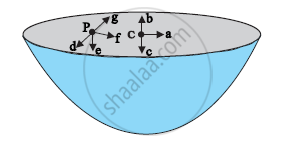
The gravitational intensity at the centre of a hemispherical shell of uniform mass density has the direction indicated by the arrow (see Fig 8.12) (i) a, (ii) b, (iii) c, (iv) 0.
Which of the Kepler’s laws of planetary motion led Newton to establish the inverse-square rule for gravitational force between two bodies ?
State and explain Kepler's laws of planetary motion. Draw diagrams to illustrate these laws.
The weight of an object is more at the poles than at the equator. Is it beneficial to purchase goods at equator and sell them at the pole? Does it matter whether a spring balance is used or an equal-beam balance is used?
Two small bodies of masses 10 kg and 20 kg are kept a distance 1.0 m apart and released. Assuming that only mutual gravitational forces are acting, find the speeds of the particles when the separation decreases to 0.5 m.
A semicircular wire has a length L and mass M. A particle of mass m is placed at the centre of the circle. Find the gravitational attraction on the particle due to the wire.
Explain the following:
People often shake the branches of a tree for getting down its fruits.
How will the force of gravitation between two objects change if the distance between them is:
Almost zero
What does a force do in the following case?
You twist a piece of rubber.
State Newton's law of gravitation. What is the difference between:
g and G?
The ______ force is much weaker than other forces in nature.
To project the rockets which of the following principle(s) is /(are) required?
Choose the wrong option.
We can shield a charge from electric fields by putting it inside a hollow conductor. Can we shield a body from the gravitational influence of nearby matter by putting it inside a hollow sphere or by some other means?
Four identical particles of equal masses 1 kg made to move along the circumference of a circle of radius 1 m under the action of their own mutual gravitational attraction. The speed of each particle will be ______.
Newton's universal law of gravitation applies to ______.
Newton formulated the Universal Law of Gravitation by combining the ideas of which two scientists with his own Laws of Motion?
