Advertisements
Advertisements
Question
What happens to the force between two objects, if the mass of one object is doubled?
Advertisements
Solution
From the relationship,
F = `(Gm_1m_2)/R^2`
If the mass of one object (say body 1) is doubled, then
F' = `(G xx (2m_1)m_2)/R^2`
F = `(2 xx Gm_1m_2)/R^2`
F = 2F
Thus, the gravitational force between the two objects gets doubled.
RELATED QUESTIONS
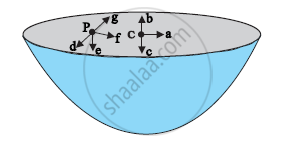
The gravitational intensity at the centre of a hemispherical shell of uniform mass density has the direction indicated by the arrow (see Fig 8.12) (i) a, (ii) b, (iii) c, (iv) 0.
Can two particles be in equilibrium under the action of their mutual gravitational force? Can three particles be? Can one of the three particles be?
A body is suspended from a spring balance kept in a satellite. The reading of the balance is W1 when the satellite goes in an orbit of radius R and is W2 when it goes in an orbit of radius 2 −R.
Write an expression for the gravitational force of attraction between two bodies of masses m1 and m2 separated by a distance r.
How will the force of gravitation between two objects change if the distance between them is:
Halved
How will the force of gravitation between two objects change if the distance between them is:
Doubled
Shown are several curves (Figure). Explain with reason, which ones amongst them can be possible trajectories traced by a projectile (neglect air friction).
If three equal masses m are placed at the three vertices of an equilateral triangle of side 1/m then what force acts on a particle of mass 2m placed at the centroid?
A hollow spherical shell of uniform density exerts what gravitational force on a point mass placed inside it?
Newton formulated the Universal Law of Gravitation by combining the ideas of which two scientists with his own Laws of Motion?
