Advertisements
Advertisements
प्रश्न
Give the applications of universal law gravitation.
Advertisements
उत्तर
Application of Newton’s law of gravitation are:
- Dimensions of the heavenly bodies can be measured using the gravitation law. Mass of the Earth, the radius of the Earth, acceleration due to gravity, etc., can be calculated with higher accuracy.
- Helps in discovering new stars and planets.
(Hi) Helps to explain germination of roots is due to the property of geotropism which is the property of a root responding to gravity. - One of the irregularities in the motion of stars is called ‘Wobble’ leads to the disturbance in the motion of a planet nearby. In this condition, the mass of the star can be calculated using the law of gravitation.
- Helps to predict the path of the astronomical bodies.
APPEARS IN
संबंधित प्रश्न
If you compare the gravitational force on the Earth due to the Sun to that due to the Moon, you would find that the Sun’s pull is greater than the Moon’s pull. (You can check this yourself using the data available in the succeeding exercises). However, the tidal effect of the Moon’s pull is greater than the tidal effect of Sun. Why?
A person brings a mass of 1 kg from infinity to a point A. Initially the mass was at rest but it moves at a speed of 2 m s −1 as it reaches A. The work done by the person on the mass is −3 J. The potential at A is
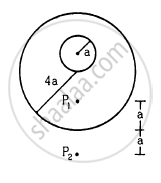
A uniform metal sphere of radius a and mass M is surrounded by a thin uniform spherical shell of equal mass and radius 4a (In the following figure). The centre of the shell falls on the surface of the inner sphere. Find the gravitational field at the points P1 and P2 shown in the figure.
Where will you weigh more: at the moon's surface or at the earth's surface?
Name and state the action and reaction in the following case:
A person walking on the ground.
Is there a gravitational attraction between you and the book? Explain.
An apple falls towards the earth due to its gravitational force. The apple also attracts the earth with the same force. Why do we not see the earth rising towards the apple? Explain.
The distance-time values for an object moving along straight line are given below:
| Time (s) | Distance (m) |
| 0 | 0 |
| 1 | 1 |
| 2 | 8 |
| 3 | 27 |
Answer the following question.
What are the dimensions of the universal gravitational constant?
If the law of gravitation, instead of being inverse-square law, becomes an inverse-cube law- ______.
- planets will not have elliptic orbits.
- circular orbits of planets is not possible.
- projectile motion of a stone thrown by hand on the surface of the earth will be approximately parabolic.
- there will be no gravitational force inside a spherical shell of uniform density.
