Advertisements
Advertisements
प्रश्न
A ball is thrown vertically upwards. It goes to a height 20 m and then returns to the ground. Taking acceleration due to gravity g to be 10 ms-2 , find :
the total time of journey of the ball .
Advertisements
उत्तर
Given, maximum height reached, s = 20 m
Acceleration due to gravity, g = 10 m/s2
Now total time for which the ball remains in air, t = 2u/g.
Or, t = 2 (20)/(10).
Or, t = 4s.
APPEARS IN
संबंधित प्रश्न
Choose the correct alternative:
Acceleration due to gravity increases/decreases with increasing altitude.
Choose the correct alternative:
Acceleration due to gravity is independent of mass of the earth/mass of the body.
Let V and E be the gravitational potential and gravitational field at a distance r from the centre of a uniform spherical shell. Consider the following two statements :
(A) The plot of V against r is discontinuous.
(B) The plot of E against r is discontinuous.
Derive an expression for the gravitational field due to a uniform rod of length L and mass M at a point on its perpendicular bisector at a distance d from the centre.
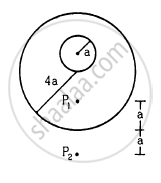
A uniform metal sphere of radius a and mass M is surrounded by a thin uniform spherical shell of equal mass and radius 4a (In the following figure). The centre of the shell falls on the surface of the inner sphere. Find the gravitational field at the points P1 and P2 shown in the figure.
Law of gravitation gives the gravitational force between
As observed from earth, the sun appears to move in an approximate circular orbit. For the motion of another planet like mercury as observed from earth, this would ______.
Newton's universal law of gravitation applies to ______.
The acceleration of the Moon towards the Earth is approximately ______.
Newton formulated the Universal Law of Gravitation by combining the ideas of which two scientists with his own Laws of Motion?
