Advertisements
Advertisements
Question
State Newton's law of gravitation. What is the difference between:
g and G?
Advertisements
Solution
Newton law of gravitation is that every object in the universe attracts every other object with a force directly proportional to the product of their masses and inversely proportional to the square of the distance between them.
'g' is the acceleration due to earth's gravity and 'G' is universal gravitational constant.
APPEARS IN
RELATED QUESTIONS
What happens to the force between two objects, if the mass of one object is doubled?
Calculate the force of gravitation between the earth and the Sun, given that the mass of the earth = 6 × 1024 kg and of the Sun = 2 × 1030 kg. The average distance between the two is 1.5 × 10¹¹ m.
Choose the correct alternative:
Acceleration due to gravity is independent of mass of the earth/mass of the body.
Four particles having masses m, 2m, 3m and 4m are placed at the four corners of a square of edge a. Find the gravitational force acting on a particle of mass m placed at the centre.
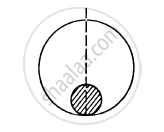
A solid sphere of mass m and radius r is placed inside a hollow thin spherical shell of mass M and radius R as shown in the following figure . A particle of mass m' is placed on the line joining the two centres at a distance x from the point of contact of the sphere and the shell. Find the magnitude of the resultant gravitational force on this particle due to the sphere and the shell if (a) r < x < 2r, (b) 2r < x < 2R and (c) x > 2R.
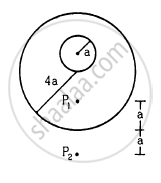
A uniform metal sphere of radius a and mass M is surrounded by a thin uniform spherical shell of equal mass and radius 4a (In the following figure). The centre of the shell falls on the surface of the inner sphere. Find the gravitational field at the points P1 and P2 shown in the figure.
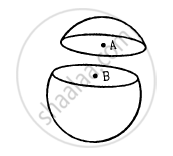
A thin spherical shell having uniform density is cut in two parts by a plane and kept separated as shown in the following figure. The point A is the centre of the plane section of the first part and B is the centre of the plane section of the second part. Show that the gravitational field at A due to the first part is equal in magnitude to the gravitational field at B due to the second part.
Explain the following:
People often shake the branches of a tree for getting down its fruits.
How will the force of gravitation between two objects change if the distance between them is:
Doubled
Newton's universal law of gravitation applies to ______.
