Advertisements
Advertisements
Question
Live wire and neutral wires have a 220 V potential difference.
Options
Right
Wrong
Advertisements
Solution
Live wire and neutral wires have a 220 V potential difference- Right
APPEARS IN
RELATED QUESTIONS
An electric heater is connected to the 230 V mains supply. A current of 8 A flows through the heater.
(b) How much energy is transferred to the heater each second?
What is nichrome? State its one use.
Why are the coils of electric irons and electric toasters made of an alloy rather than a pure metal?
Why is a series arrangement not used for connecting domestic electrical appliances in a circuit?
Derive the expression for the heat produced due to a current 'I' flowing for a time interval 't' through a resistor 'R' having a potential difference 'V' across its ends. With which name is this relation known?
The heat produced by passing an electric current through a fixed resistor is proportional to the square of:
(a) magnitude of resistance of the resistor
(b) temperature of the resistor
(c) magnitude of current
(d) time for which current is passed
An electric iron is connected to the mains power supply of 220 V. When the electric iron is adjusted at 'minimum heating' it consumes a power of 360 W but at 'maximum heating' it takes a power of 840 W. Calculate the current and resistance in each case.
Three heaters each rated 250 W, 100 V are connected in parallel to a 100 V supply. Calculate:
- the total current taken from the supply
- the resistance of each heater and
- the energy supplied in kWh to the three heaters in 5 hours.
Give a scientific reason.
Tungsten metal is used to make a solenoid type coil in an electric bulb.
Give Scientific reason.
In practice, the unit kWh is used for the measurement of electrical energy, rather than joule.
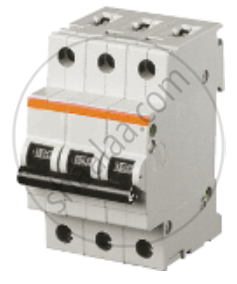
Identify the figure and give its use.
Rewrite the following statement by selecting the correct option:
1 A = ____________ mA.
Which of the following substance contracts on heating?
Write two devices based on the heating effect of electric current.
Name any two appliances which works on the phenomenon of heating effect of electric current.
How can overloading be avoided?
Explain the heating effect of electric current.
Heating effect of current is called ______
A fuse wire repeatedly gets burnt when used with a good heater. It is advised to use a fuse wire of:
Which of the following gases are filled in electric bulbs?
What is Joule’s heating effect? How can it be demonstrated experimentally? List its four applications in daily life.
An electric component used as a safety device is electric circuit is ______.
An electric fuse has a body made of ceramic and two points for connecting the fuse wire.
What are the uses of electromagnets?
Copper wire offers very little ______ and does not get heated up quickly.
Fuse is a strip of alloy wire which is made up of lead and tin with a very low ______.
Match the following
| 1. | Bulb | a. | Conductor |
| 2. | Electroplating | b. |
Insulator |
| 3. | Pure water | c. | Heating effect of current |
| 4. | Salt solution | d. | Chemical effect of current |
A trip switch is a ______ safety device.
The electric fuse works on the Joule heating principle.
If 220 V potential difference is applied across an electric bulb, a current of 0.45 A flows in the bulb. What must be the power of the bulb?
1 kWh is equal to ______.
In the electric equipment producing heat like iron, electric heater, boiler, toaster etc., an alloy such as nichrome is used, not pure metals.
In a set up the students coated iron nails with zinc metal and noted that, iron nails coated with zinc prevents rusting. They also observed that zinc initially acts as a physical barrier, but an extra advantage of using zinc is that it continues to prevent rusting even if the layer of zinc is damaged. Name this process of rust prevention and give any two other methods to prevent rusting.
An electric iron is rated 220 V, 2 kW. If the iron is used for 3h daily find the cost of running it for one week if it costs ₹ 4.25 per kWh.
