Advertisements
Advertisements
प्रश्न
If 220 V potential difference is applied across an electric bulb, a current of 0.45 A flows in the bulb. What must be the power of the bulb?
विकल्प
99 W
70 W
45 W
22 W
Advertisements
उत्तर
99 W
Explanation:
Given:
Potential difference = 220 V, Current = 0.45 A
Power (W) = Potential difference (V) × Current (A)
= 220 × 0.45 W
= 99 W
So, the bulb must be of power 99 W.
APPEARS IN
संबंधित प्रश्न
An electric heater of resistance 8 Ω draws 15 A from the service mains 2 hours. Calculate the rate at which heat is developed in the heater.
An electric room heater draws a current of 2.4 A from the 120 V supply line. What current will this room heater draw when connected to 240 V supply line?
What is nichrome? State its one use.
Why are the coils of electric irons and electric toasters made of an alloy rather than a pure metal?
How does the resistance of a wire vary with its:
diameter?
Explain why, the current that makes the heater element very hot, only slightly warms the connecting wires leading to the heater.
A heating coil has a resistance of 200 Ω. At what rate will heat be produced in it when a current of 2.5 A flows through it?
Name the material which is used for making the filaments of an electric bulb.
The heat produced by passing an electric current through a fixed resistor is proportional to the square of:
(a) magnitude of resistance of the resistor
(b) temperature of the resistor
(c) magnitude of current
(d) time for which current is passed
The elements of electrical heating devices are usually made of:
(a) tungsten
(b) bronze
(c) nichrome
(d) argon
The electrical resistivities of four materials P, Q, R and S are given below:
| P | `6.84xx10^8`Ωm |
| Q | `1.70xx10^8`Ωm |
| R | ` 1.0xx10^15`Ωm |
| s | `11.0xx10^-7`Ωm |
Which material will you use for making: (a) heating element of electric iron (b) connecting wires of electric iron (c) covering of connecting wires? Give reason for your choice in each case.
Which electric heating device in your home do you think have resistors which control the flow of electricity?
Give a scientific reason.
Tungsten metal is used to make a solenoid type coil in an electric bulb.
Identify the figure and give its use.
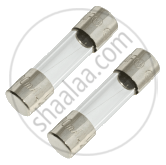
Name any six domestic appliances based on the heating effect of electric current.
Compute the heat generated while transferring 96000 coulombs of charge in two hours through a potential difference of 40 V.
The ‘live’ and the ‘neutral’ wires have potential difference of _______.
In an electric bulb, coil of _______ metal is used.
Right or wrong sentence.
Live wire and neutral wires have a 220 V potential difference.
How can overloading be avoided?
Explain the application of heating effect of electric current in an electric bulb with a diagram.
Define fuse.
Name any two appliances which work under the principle of heating effect of current.
Mark the correct choice
- Assertion: Electric appliances with a metallic body have three wire connections.
- Reason: Three-pin connections reduce the heating of the connecting wires.
A current of 1 A is drawn by a filament of an electric bulb. Number of electrons passing through a cross-section of the filament in 16 seconds would be roughly:
An electric bulb is connected to a 220 V generator. The current is 0.50 A. What is the power of the bulb?
How does use of a fuse wire protect electrical appliances?
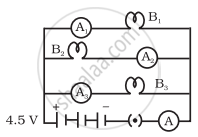
B1, B2 and B3 are three identical bulbs connected as shown in Figure. When all the three bulbs glow, a current of 3A is recorded by the ammeter A.
- What happens to the glow of the other two bulbs when the bulb B1 gets fused?
- What happens to the reading of A1, A2, A3 and A when the bulb B2 gets fused?
- How much power is dissipated in the circuit when all the three bulbs glow together?
Three incandescent bulbs of 100 W each are connected in series in an electric circuit. In another circuit another set of three bulbs of the same wattage are connected in parallel to the same source.
- Will the bulb in the two circuits glow with the same brightness? Justify your answer.
- Now let one bulb in both the circuits get fused. Will the rest of the bulbs continue to glow in each circuit? Give reason.
Unscramble the following words:
SFEU
Can we use the same fuse in a geyser and a television set? Explain.
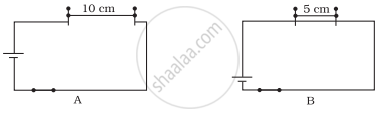
Paheli took a wire of length 10 cm. Boojho took a wire of 5 cm of the same material and thickness. Both of them connected the wires as shown in the circuit given in the following figure. The current flowing in both the circuits is the same.
- Will the heat produced in both cases be equal? Explain.
- Will the heat produced be the same if the wires taken by them are of equal lengths but of different thickness? Explain.
It would cost a man Rs. 3.50 to buy 1.0 kW h of electrical energy from the Main Electricity Board. His generator has a maximum power of 2.0 kW. The generator produces energy at this maximum power for 3 hours. Calculate how much it would cost to buy the same amount of energy from the Main Electricity Board.
A student boils water in an electric kettle for 20 minutes. Using the same mains supply he wants to reduce the boiling time of water. To do so should he increase or decrease the length of the heating element? Justify your answer.
What is the heating effect of electric current?
Anannya responded to the question: Why do electrical appliances with metallic bodies are connected to the mains through a three-pin plug, whereas an electric bulb can be connected with a two-pin plug?
She wrote: Three-pin connections reduce heating of connecting wires.
- Is her answer correct or incorrect? Justify.
- What is the function of a fuse in a domestic circuit?
