- Alloys are homogeneous mixtures of metals (or metals with non-metals) with different properties than pure metals—often harder, less conductive, and with lower melting points.
- 24-carat gold is soft, so 22-carat gold (an alloy with copper or silver) is used in jewellery to improve strength.
- Solder, an alloy with a low melting point, is used to join electrical wires.
- Corrosion prevention methods include painting, galvanising, anodising, electroplating, and alloying.
- Galvanising, tinning, anodisation, and electroplating all involve protective coatings to prevent corrosion, while alloying enhances durability and resistance.
Topics
Gravitation
- Concept of Gravitation
- Force and Motion
- Circular Motion and Centripetal Force
- Kepler’s Laws
- Law of Orbit or Kepler's First Law
- Law of Areas or Kepler's Second Law
- Law of Periods or Kepler's Third Law
- Newton's Universal Law of Gravitation
- Uniform Circular Motion (UCM)
- Earth’s Gravitational Force
- Earth’s Gravitational Acceleration
- Mass and Weight
- Gravitational Waves
- Free Fall
- Gravitational Potential Energy
- Escape Velocity
- Weightlessness in Space
Periodic Classification of Elements
- Classification of Elements
- Dobereiner’s Triads
- Newland's Law of Octaves
- Mendeleev’s Periodic Table
- Insights into Mendeleev’s Periodic Table
- Modern Periodic Law
- Modern Periodic Table
- Structure of the Modern Periodic Table
- Modern Periodic Table and Electronic Configuration of Elements
- Groups and Electronic Configuration
- Periods and Electronic Configuration
- Periodic Trends in the Modern Periodic Table
- Atomic Size
- Metallic and Non-metallic Characters
- Gradation in Halogen Family
Chemical Reactions and Equations
- Chemical Reaction
- Chemical Equations
- Balancing Chemical Equation
- Types of Chemical Reactions > Combination Reaction
- Types of Chemical Reactions > Decomposition Reaction
- Types of Chemical Reactions > Single Displacement Reaction
- Types of Chemical Reactions > Double Displacement Reaction
- Endothermic and Exothermic Processes
- Rate of Chemical Reaction
- Types of Chemical Reactions > Oxidation and Reduction Reactions
- Corrosion of Metals
- Factors Affecting the Rate of a Chemical Reaction
- Rancidity
Effects of Electric Current
- Electric Circuit
- Heating Effect of Electric Current
- Magnetic Effect of Electric Current
- Right-hand Thumb Rule
- Applications of Biot-Savart's Law > Magnetic Field at the Axis of a Circular Current-carrying Loop
- Applications of Ampere’s Circuital Law > Magnetic Field of a Long Straight Solenoid
- Force on a Current-Carrying Conductor Placed in a Uniform Magnetic Field
- Fleming’s Left Hand Rule
- Electric Motor
- Introduction to Electromagnetic Induction
- Galvanometer
- Faraday's Laws of Electromagnetic Induction
- Fleming’s Right Hand Rule
- Alternating current (AC) and Direct Current (DC)
- Electric Generator
Heat
Refraction of Light
Lenses
- Concept of Lenses
- Images Formed by Convex Lenses
- Images Formed by Concave Lenses
- Sign Convention
- Lens Formula and Magnification
- Magnification
- Power of a Lens
- Combination of Lenses
- Human Eye
- Defects of Vision and Their Corrections > Myopia
- Defects of Vision and Their Corrections > Hypermetropia
- Defects of Vision and Their Corrections > Presbyopia
- Apparent Size of an Object
- Use of Concave Lenses
- Use of Convex Lenses
- Persistence of Vision
Metallurgy
- Physical Properties of Metal
- Physical Properties of Non-metal
- Chemical Properties of Metal
- Reactions of Metals
- Reactivity Series of Metals
- Chemical Properties of Non-metal
- Ionic Compounds
- Metallurgy
- Basic Principles of Metallurgy > Concentration of Ores
- Basic Principles of Metallurgy > Extraction of Metals
- Basic Principles of Metallurgy > Refining of Metals
- Corrosion of Metals
- Prevention of Corrosion
Carbon Compounds
- Bonds in Carbon Compounds
- Carbon: A Versatile Element
- Hydrocarbons
- Straight chains, Branched chains, and Rings of Carbon atoms
- Functional Groups in Carbon Compounds
- Nomenclature
- The IUPAC System of Nomenclature
- Homologous Series
- Chemical Properties of Carbon Compounds > Combustion
- Chemical Properties of Carbon Compounds > Oxidation
- Chemical Properties of Carbon Compounds > Addition Reaction
- Chemical Properties of Carbon Compounds > Substitution Reaction
- Ethanol
- Ethanoic Acid
- Macromolecules and Polymers
Space Missions
School of Elements
The Magic of Chemical Reactions
- Types of Chemical Reactions > Combination Reaction
- Types of Chemical Reactions > Decomposition Reaction
- Types of Chemical Reactions > Single Displacement Reaction
- Types of Chemical Reactions > Double Displacement Reaction
- Chemical Properties of Carbon Compounds > Oxidation
- Types of Double Displacement: Neutralization Reaction
The Acid Base Chemistry
The Electric Spark
All about Electromagnetism
- Magnetic force
- Bar Magnet and Solenoid Analogy
- Right-hand Thumb Rule
- Applications of Biot-Savart's Law > Magnetic Field at the Axis of a Circular Current-carrying Loop
- Applications of Ampere’s Circuital Law > Magnetic Field of a Long Straight Solenoid
- Force on a Current-Carrying Conductor Placed in a Uniform Magnetic Field
- Electric Motor
- Introduction to Electromagnetic Induction
- Alternating-Current Generator
- Simple D.C. Motor
- Household Electrical Circuits
Wonders of Light 1
Wonders of Light 2
Striving for better Environment 1
- Abatement of Pollution
- Sustainable Use of Resources
Maharashtra State Board: Class 10
Coating with a Protective Layer
Corrosion is a natural process that deteriorates metals due to environmental factors like moisture, oxygen, and chemicals. To protect metals, especially iron, various methods are used to prevent rusting and extend the lifespan of metal objects. The rate of corrosion can be reduced by isolating metals from direct contact with air and moisture.
A layer of paint, oil, grease, varnish, or enamel is applied to block air and moisture from reaching the metal surface.
- Painting and Varnishing: Metals like iron gates, railings, and furniture are coated with paint or varnish to prevent rust. However, if the paint gets scratched, rusting starts underneath.
- Greasing and Oiling: It is used for moving parts of machines, gears, and bicycle chains to prevent rusting by reducing moisture contact.
- Enamelling: A glassy layer fused onto metals to provide long-term corrosion resistance.
Limitations:
- If the coating gets scratched or damaged, rusting can begin underneath.
- It requires regular maintenance and reapplication over time.
Maharashtra State Board: Class 10
Metal Plating (Galvanisation, Tinning, Electroplating)
A non-corrodible metal is coated onto corrodible metals like iron or steel to prevent corrosion.
1. Galvanisation: A thin layer of zinc is applied to iron or steel to prevent rusting. Examples include shiny iron nails and pins. Zinc corrodes before iron because it is more electropositive, but once the zinc layer wears off, iron starts rusting.
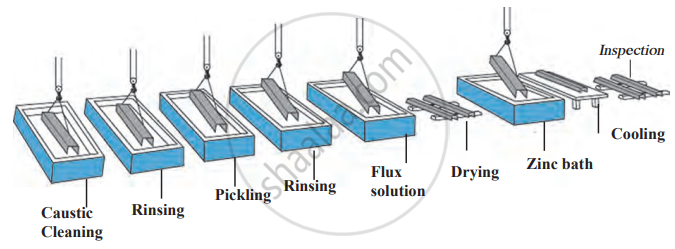
Galvanising Process
2. Tinning: Molten tin is coated on brass or copper utensils (also called kalhaee) to prevent corrosion. This protects against the greenish poisonous layer that forms on copper and brass, especially when in contact with acidic foods like buttermilk or curry.
3. Electroplating: A less reactive metal (silver, gold, or chromium) is deposited onto a more reactive metal using electrolysis. Examples include silver-plated spoons, gold-plated jewellery, and chromium-plated taps.
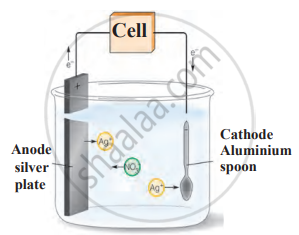
Electroplating
Limitations:
- Over time, the protective layer wears off, exposing the metal to corrosion.
- The plating process can be expensive.
Maharashtra State Board: Class 10
Anodisation (Formation of Oxide Layer)
In anodisation, metals like aluminium and copper are coated with a thin and strong oxide layer using electrolysis.
- The oxide layer is uniform, strong, and durable, preventing further oxidation.
- Protection can be increased by making the oxide layer thicker.
Example: Anodised aluminium cookware forms a protective Al₂O₃ layer, preventing oxidation and corrosion.
Limitations: Only applicable to certain metals like aluminium and copper.
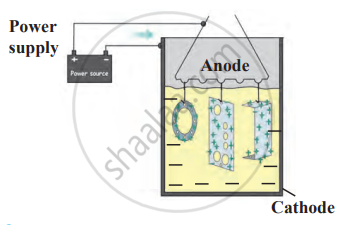
Anodization
Maharashtra State Board: Class 10
Alloying (Corrosion-Resistant Alloys)
Metals are mixed with other metals or nonmetals to create alloys, which are stronger and more resistant to corrosion.
- It provides permanent protection against corrosion.
- Improves the strength and durability of metals.
Examples,
- Bronze (90% copper + 10% tin): Used for statues and sculptures, resistant to sun and rain.
- Stainless Steel (74% iron + 18% chromium + 8% carbon): Does not rust or stain, making it ideal for utensils, construction materials, and surgical instruments.
- Coins made from alloys: Modern coins are made from corrosion-resistant alloys to prevent wear and tear.
Limitations: Expensive and difficult to separate metals once alloyed.

Coins made from various alloys
CBSE: Class 10
Maharashtra State Board: Class 10
Maharashtra State Board: Class 10
