At the end of rancidification, fats, oils, and other lipids break down, producing highly reactive molecules. These compounds cause the unpleasant smell and taste in rancid food. Additionally, rancidification can lead to the loss of essential vitamins, reducing the nutritional value of food.
Topics
Chemical Reactions and Equations
- Chemical Reactions in Daily Life
- Chemical Equations
- Balancing Chemical Equation
- Types of Chemical Reactions > Combination Reaction
- Types of Chemical Reactions > Decomposition Reaction
- Types of Chemical Reactions > Single Displacement Reaction
- Types of Chemical Reactions > Double Displacement Reaction
- Chemical Properties of Carbon Compounds > Oxidation
- The Effects of Oxidation Reactions in Everyday Life
Acids, Bases and Salts
- Acids and Bases in Daily Life
- Acids and Bases in the Laboratory
- Acids and Bases React with Metals
- Reaction of Metal Carbonates with Acids
- Acids and Bases Reaction with each other
- Reaction of Metallic Oxides with Acids
- Reaction of a Non-metallic Oxide with Base
- Common Properties of Acids and Bases
- The pH Scale
- Importance of pH in Everyday Life
- Salts > Family of Salts
- Salts > pH of Salts
- Salts > Chemicals from Common Salt
- Salts > Water in Salt Crystals
Metals and Non-metals
Carbon and its Compounds
- Importance of Carbon
- The Covalent Bond
- Allotropes of Carbon > Diamond
- Allotropes of Carbon > Graphite
- Allotropes of Carbon > Fullerene
- Carbon: A Versatile Element
- Organic Compounds
- Classification of Hydrocarbons
- Carbon Compounds: Chains, Branches, Rings
- Homologous Series
- Nomenclature
- Chemical Properties of Carbon Compounds > Combustion
- Ethanol
- Ethanoic Acid
- Soaps and Detergents
Life Processes
- Life Processes in Living Organisms
- Nutrition
- Autotrophic Nutrition
- Heterotrophic Nutrition
- Nutrition in Human Beings
- Dental Caries
- Production of ATP
- Blood Circulatory System
- Blood Vessels Entering and Leaving The Heart
- Valves of the Heart
- Tissue Fluid (Or Intercellular Fluid)
- Transportation in Plants
- Transportation of Water
- Excretion
- Excretion in Human Beings
- Kidney and Its Internal Structure
- Structure of a Kidney Tubule (Nephrons)
- Dialysis and Artificial Kidney
- Excretion in Plants
- Organ and Body Donation
Control and Co-ordination
How do Organisms Reproduce?
Heredity
Light – Reflection and Refraction
- Light and Its Straight-Line Propagation
- Reflection of Light
- Spherical Mirrors
- Image Formation by Spherical Mirrors
- Representation of Images Formed by Spherical Mirrors
- Image Formation by Concave Mirror
- Image Formation by a Convex Mirror
- Sign Convention for Reflection by Spherical Mirrors
- Ray Optics - Mirror Formula
- Refraction of Light
- Refraction through a Rectangular Glass Slab
- The Refractive Index
- Refraction by Spherical Lenses
- Image Formation by Lenses
- Image Formation in Lenses Using Ray Diagrams
- Sign Convention for Spherical Lenses
- Lens Formula
- Power of a Lens
The Human Eye and the Colourful World
Electricity
Magnetic Effects of Electric Current
- Magnetic Effect of Electric Current
- Applications of Biot-Savart's Law > Magnetic Field due to a Finite Straight Current-Carrying Wire
- Magnetic Field Due to a Current-Carrying Conductor
- Right-hand Thumb Rule
- Applications of Biot-Savart's Law > Magnetic Field at the Centre of a Circular Loop
- Applications of Ampere’s Circuital Law > Magnetic Field of a Long Straight Solenoid
- Force on a Current Carrying Conductor in a Magnetic Field
- Fleming’s Left Hand Rule
- Magnetism in Medicine
- Domestic Electric Circuits
Our Environment
- Definition: Corrosion
- Definition: Rancidity
Maharashtra State Board: Class 10
Rancidity
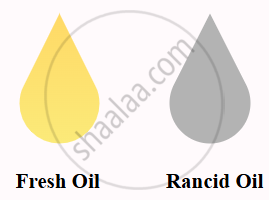
Rancidity is the spoilage of food caused by the oxidation of fats and oils, making the food undesirable for consumption. It leads to foul odour, unpleasant taste, and reduced nutritional value. Consuming rancid food may have harmful health effects.
Causes:
- Oxidation of fats and oils in food.
- Formation of highly reactive molecules responsible for bad odour and taste.
- Exposure to air, light, and heat accelerates the process.
Effects:
- Unpleasant odour and taste in food items like nuts, potato chips, and fried foods.
- Nutrient loss, making food less healthy.
- Health risks if consumed in large amounts.
Prevention:
- Adding antioxidants (substances that prevent oxidation) to food.
- Storing food in airtight containers to reduce exposure to air.
- Refrigeration to slow down oxidation.
- Replacing oxygen with nitrogen gas in food packaging, such as chip bags.
Maharashtra State Board: Class 10
Stages of Rancidity
1. Initiation Reaction
External factors like heat and air trigger the reaction. This causes the formation of free radicals (highly reactive atoms or molecules with unpaired electrons).
RH → R + H**
(RH represents a fat molecule, and R is a free radical formed after losing hydrogen.)*
2. Propagation Reaction
The *free radical (R) reacts with oxygen (O₂), forming *peroxides (ROO). These peroxides further react with unsaturated fatty acids, producing more radicals, continuing the chain reaction.
R + O₂ → ROO** (peroxide formation)
3. Termination Reaction
The reaction stops when two radicals combine to form a stable single bond, preventing further oxidation.
ROO + ROO → End Products**
CBSE: Class 10
Definition: Corrosion
CBSE: Class 10
Definition: Rancidity
When fats and oils are oxidised, they become rancid and their smell and taste change.
