Topics
Gravitation
- Concept of Gravitation
- Force and Motion
- Circular Motion and Centripetal Force
- Kepler’s Laws
- Law of Orbit or Kepler's First Law
- Law of Areas or Kepler's Second Law
- Law of Periods or Kepler's Third Law
- Newton's Universal Law of Gravitation
- Uniform Circular Motion (UCM)
- Earth’s Gravitational Force
- Earth’s Gravitational Acceleration
- Mass and Weight
- Gravitational Waves
- Free Fall
- Gravitational Potential Energy
- Escape Velocity
- Weightlessness in Space
Periodic Classification of Elements
- Classification of Elements
- Dobereiner’s Triads
- Newland's Law of Octaves
- Mendeleev’s Periodic Table
- Insights into Mendeleev’s Periodic Table
- Modern Periodic Law
- Modern Periodic Table
- Structure of the Modern Periodic Table
- Modern Periodic Table and Electronic Configuration of Elements
- Groups and Electronic Configuration
- Periods and Electronic Configuration
- Periodic Trends in the Modern Periodic Table
- Atomic Size
- Metallic and Non-metallic Characters
- Gradation in Halogen Family
Chemical Reactions and Equations
- Chemical Reaction
- Chemical Equations
- Balancing Chemical Equation
- Types of Chemical Reactions > Combination Reaction
- Types of Chemical Reactions > Decomposition Reaction
- Types of Chemical Reactions > Single Displacement Reaction
- Types of Chemical Reactions > Double Displacement Reaction
- Endothermic and Exothermic Processes
- Rate of Chemical Reaction
- Types of Chemical Reactions > Oxidation and Reduction Reactions
- Corrosion of Metals
- Factors Affecting the Rate of a Chemical Reaction
- Rancidity
Effects of Electric Current
- Electric Circuit
- Heating Effect of Electric Current
- Magnetic Effect of Electric Current
- Right-hand Thumb Rule
- Applications of Biot-Savart's Law > Magnetic Field at the Axis of a Circular Current-carrying Loop
- Applications of Ampere’s Circuital Law > Magnetic Field of a Long Straight Solenoid
- Force on a Current-Carrying Conductor Placed in a Uniform Magnetic Field
- Fleming’s Left Hand Rule
- Electric Motor
- Introduction to Electromagnetic Induction
- Galvanometer
- Faraday's Laws of Electromagnetic Induction
- Fleming’s Right Hand Rule
- Alternating current (AC) and Direct Current (DC)
- Electric Generator
Heat
Refraction of Light
Lenses
- Concept of Lenses
- Images Formed by Convex Lenses
- Images Formed by Concave Lenses
- Sign Convention
- Lens Formula and Magnification
- Magnification
- Power of a Lens
- Combination of Lenses
- Human Eye
- Defects of Vision and Their Corrections > Myopia
- Defects of Vision and Their Corrections > Hypermetropia
- Defects of Vision and Their Corrections > Presbyopia
- Apparent Size of an Object
- Use of Concave Lenses
- Use of Convex Lenses
- Persistence of Vision
Metallurgy
- Physical Properties of Metal
- Physical Properties of Non-metal
- Chemical Properties of Metal
- Reactions of Metals
- Reactivity Series of Metals
- Chemical Properties of Non-metal
- Ionic Compounds
- Metallurgy
- Basic Principles of Metallurgy > Concentration of Ores
- Basic Principles of Metallurgy > Extraction of Metals
- Basic Principles of Metallurgy > Refining of Metals
- Corrosion of Metals
- Prevention of Corrosion
Carbon Compounds
- Bonds in Carbon Compounds
- Carbon: A Versatile Element
- Hydrocarbons
- Straight chains, Branched chains, and Rings of Carbon atoms
- Functional Groups in Carbon Compounds
- Nomenclature
- The IUPAC System of Nomenclature
- Homologous Series
- Chemical Properties of Carbon Compounds > Combustion
- Chemical Properties of Carbon Compounds > Oxidation
- Chemical Properties of Carbon Compounds > Addition Reaction
- Chemical Properties of Carbon Compounds > Substitution Reaction
- Ethanol
- Ethanoic Acid
- Macromolecules and Polymers
Space Missions
School of Elements
The Magic of Chemical Reactions
- Types of Chemical Reactions > Combination Reaction
- Types of Chemical Reactions > Decomposition Reaction
- Types of Chemical Reactions > Single Displacement Reaction
- Types of Chemical Reactions > Double Displacement Reaction
- Chemical Properties of Carbon Compounds > Oxidation
- Types of Double Displacement: Neutralization Reaction
The Acid Base Chemistry
The Electric Spark
All about Electromagnetism
- Magnetic force
- Bar Magnet and Solenoid Analogy
- Right-hand Thumb Rule
- Applications of Biot-Savart's Law > Magnetic Field at the Axis of a Circular Current-carrying Loop
- Applications of Ampere’s Circuital Law > Magnetic Field of a Long Straight Solenoid
- Force on a Current-Carrying Conductor Placed in a Uniform Magnetic Field
- Electric Motor
- Introduction to Electromagnetic Induction
- Alternating-Current Generator
- Simple D.C. Motor
- Household Electrical Circuits
Wonders of Light 1
Wonders of Light 2
Striving for better Environment 1
- Abatement of Pollution
- Sustainable Use of Resources
Introduction to Space Launch Technology:
Space launch technology is the science and engineering used to send rockets, satellites, and spacecraft from Earth's surface into space. It involves the design, propulsion, staging, guidance, and payload deployment systems that allow a launch vehicle to overcome Earth's gravity.
A rocket is a special vehicle that generates powerful thrust using engines and fuel combustion. It carries a payload—which could be a satellite, a probe, or a spacecraft with astronauts—into orbit or deeper into space. After launch, the used-up parts of the rocket (stages) fall back to Earth.
India’s space agency, ISRO (Indian Space Research Organisation), has developed several successful launch vehicles, including:
- PSLV (Polar Satellite Launch Vehicle): Used for launching satellites into polar orbits, including the Mars Orbiter Mission.
- GSLV (Geosynchronous Satellite Launch Vehicle): Designed to carry heavier satellites into higher geosynchronous orbits.
Space launch technology is crucial for space exploration, planetary studies, satellite communication, and national space missions.
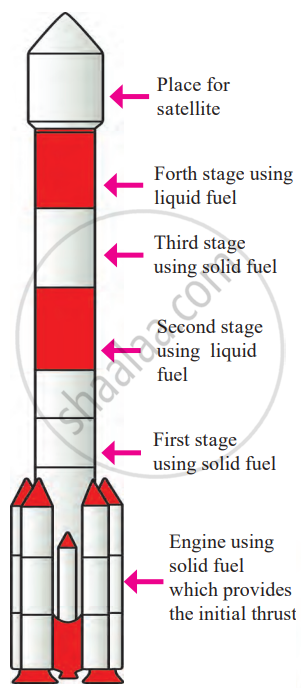
a. Structure of PSLV made by ISRO
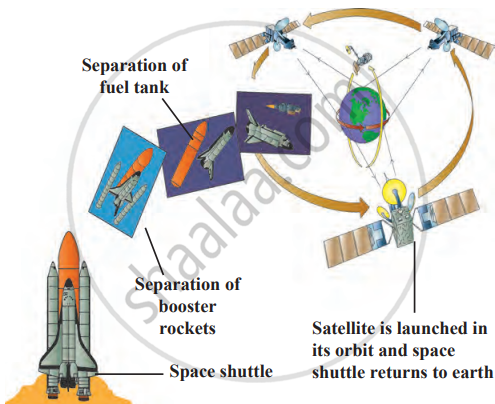
b. Space shuttle
Working of Launch Vehicles
A launch vehicle is a rocket system used to place satellites or spacecraft into specific orbits. It works based on Newton’s Third Law of Motion: For every action, there is an equal and opposite reaction.
| Component | Purpose | Description | Examples | Remarks |
|---|---|---|---|---|
| Rocket Propulsion System | Generate thrust to lift the rocket off the ground | Burns fuel to produce hot gases expelled backward | PSLV’s solid-fuel first stage | Based on Newton’s Third Law |
| Multiple Stages | Enhance efficiency by discarding used stages | Most rockets have 2–4 stages, each with engine and fuel | PSLV's four-stage structure | Reduces vehicle weight as it ascends |
| Fuel and Propellant | Provide the energy needed for propulsion | Uses solid, liquid, or hybrid fuels like LH₂ and LOX | GSLV uses solid and cryogenic liquid fuels | Solid = more thrust; Liquid = better control |
| Guidance and Control Systems | Steer and stabilize the rocket's path | Includes sensors, software, and hardware for trajectory control | Autopilot systems in PSLV and GSLV | Essential for accurate orbit insertion |
| Payload and Payload Fairing | Protect and deliver the satellite or spacecraft | Encases the payload; fairing is jettisoned once in space | Satellite enclosed in PSLV’s nose cone | Payload is exposed only after exiting the atmosphere |
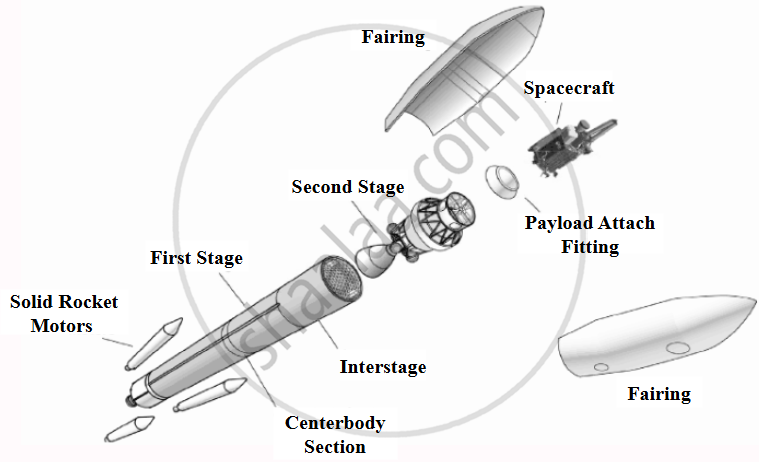
Key Points: Satellite Launch Vehicles
- Satellite launch vehicles work on Newton’s third law—expelling gas creates thrust to lift the rocket.
- Launch vehicles use multiple stages to reduce weight and increase speed as they rise.
- Fuel type and structure of launch vehicles depend on the satellite’s weight and target orbit.
- PSLV (by ISRO) is a multi-stage launch vehicle used to place satellites in orbit.
- Unlike rockets, reusable space shuttles (such as NASA's) can return and be reused.
