Topics
Gravitation
- Concept of Gravitation
- Force and Motion
- Circular Motion and Centripetal Force
- Kepler’s Laws
- Law of Orbit or Kepler's First Law
- Law of Areas or Kepler's Second Law
- Law of Periods or Kepler's Third Law
- Newton's Universal Law of Gravitation
- Uniform Circular Motion (UCM)
- Earth’s Gravitational Force
- Earth’s Gravitational Acceleration
- Mass and Weight
- Gravitational Waves
- Free Fall
- Gravitational Potential Energy
- Escape Velocity
- Weightlessness in Space
Periodic Classification of Elements
- Classification of Elements
- Dobereiner’s Triads
- Newland's Law of Octaves
- Mendeleev’s Periodic Table
- Insights into Mendeleev’s Periodic Table
- Modern Periodic Law
- Modern Periodic Table
- Structure of the Modern Periodic Table
- Modern Periodic Table and Electronic Configuration of Elements
- Groups and Electronic Configuration
- Periods and Electronic Configuration
- Periodic Trends in the Modern Periodic Table
- Atomic Size
- Metallic and Non-metallic Characters
- Gradation in Halogen Family
Chemical Reactions and Equations
- Chemical Reaction
- Chemical Equations
- Balancing Chemical Equation
- Types of Chemical Reactions > Combination Reaction
- Types of Chemical Reactions > Decomposition Reaction
- Types of Chemical Reactions > Single Displacement Reaction
- Types of Chemical Reactions > Double Displacement Reaction
- Endothermic and Exothermic Processes
- Rate of Chemical Reaction
- Types of Chemical Reactions > Oxidation and Reduction Reactions
- Corrosion of Metals
- Factors Affecting the Rate of a Chemical Reaction
- Rancidity
Effects of Electric Current
- Electric Circuit
- Heating Effect of Electric Current
- Magnetic Effect of Electric Current
- Right-hand Thumb Rule
- Applications of Biot-Savart's Law > Magnetic Field at the Axis of a Circular Current-carrying Loop
- Applications of Ampere’s Circuital Law > Magnetic Field of a Long Straight Solenoid
- Force on a Current-Carrying Conductor Placed in a Uniform Magnetic Field
- Fleming’s Left Hand Rule
- Electric Motor
- Introduction to Electromagnetic Induction
- Galvanometer
- Faraday's Laws of Electromagnetic Induction
- Fleming’s Right Hand Rule
- Alternating current (AC) and Direct Current (DC)
- Electric Generator
Heat
Refraction of Light
Lenses
- Concept of Lenses
- Images Formed by Convex Lenses
- Images Formed by Concave Lenses
- Sign Convention
- Lens Formula and Magnification
- Magnification
- Power of a Lens
- Combination of Lenses
- Human Eye
- Defects of Vision and Their Corrections > Myopia
- Defects of Vision and Their Corrections > Hypermetropia
- Defects of Vision and Their Corrections > Presbyopia
- Apparent Size of an Object
- Use of Concave Lenses
- Use of Convex Lenses
- Persistence of Vision
Metallurgy
- Physical Properties of Metal
- Physical Properties of Non-metal
- Chemical Properties of Metal
- Reactions of Metals
- Reactivity Series of Metals
- Chemical Properties of Non-metal
- Ionic Compounds
- Metallurgy
- Basic Principles of Metallurgy > Concentration of Ores
- Basic Principles of Metallurgy > Extraction of Metals
- Basic Principles of Metallurgy > Refining of Metals
- Corrosion of Metals
- Prevention of Corrosion
Carbon Compounds
- Bonds in Carbon Compounds
- Carbon: A Versatile Element
- Hydrocarbons
- Straight chains, Branched chains, and Rings of Carbon atoms
- Functional Groups in Carbon Compounds
- Nomenclature
- The IUPAC System of Nomenclature
- Homologous Series
- Chemical Properties of Carbon Compounds > Combustion
- Chemical Properties of Carbon Compounds > Oxidation
- Chemical Properties of Carbon Compounds > Addition Reaction
- Chemical Properties of Carbon Compounds > Substitution Reaction
- Ethanol
- Ethanoic Acid
- Macromolecules and Polymers
Space Missions
School of Elements
The Magic of Chemical Reactions
- Types of Chemical Reactions > Combination Reaction
- Types of Chemical Reactions > Decomposition Reaction
- Types of Chemical Reactions > Single Displacement Reaction
- Types of Chemical Reactions > Double Displacement Reaction
- Chemical Properties of Carbon Compounds > Oxidation
- Types of Double Displacement: Neutralization Reaction
The Acid Base Chemistry
The Electric Spark
All about Electromagnetism
- Magnetic force
- Bar Magnet and Solenoid Analogy
- Right-hand Thumb Rule
- Applications of Biot-Savart's Law > Magnetic Field at the Axis of a Circular Current-carrying Loop
- Applications of Ampere’s Circuital Law > Magnetic Field of a Long Straight Solenoid
- Force on a Current-Carrying Conductor Placed in a Uniform Magnetic Field
- Electric Motor
- Introduction to Electromagnetic Induction
- Alternating-Current Generator
- Simple D.C. Motor
- Household Electrical Circuits
Wonders of Light 1
Wonders of Light 2
Striving for better Environment 1
- Abatement of Pollution
- Sustainable Use of Resources
Maharashtra State Board: Class 10
Introduction to Artificial satellites
A satellite is any object that orbits a planet.
- Natural satellites occur naturally, like the Moon orbiting Earth.
- Artificial satellites are manmade machines launched into space to orbit Earth or other planets for specific purposes.
Artificial satellites are human-made objects designed to orbit the Earth or other planets. They serve many purposes, such as communication, weather forecasting, navigation, scientific research, and military surveillance. These satellites carry various instruments to transmit and receive signals and gather data from space.
- The first artificial satellite, Sputnik 1, was launched by the Soviet Union on October 4, 1957.
- Since then, many countries have developed and launched satellites.
- Today, over 3000 active satellites orbit Earth, and thousands more are inactive or considered space junk.
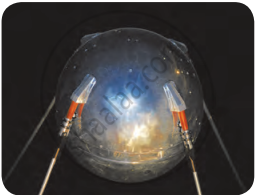
Sputnik
Maharashtra State Board: Class 10
Types of Satellite and Their Functions (India)
| Type of Satellite | Function | Indian Satellite Series | Launch Vehicle | Example Satellites | Remarks |
|---|---|---|---|---|---|
| Weather Satellite | Study and prediction of weather | INSAT, GSAT | GSLV | INSAT-3D, Kalpana-1 | Used by IMD for forecasting |
| Communication Satellite | Global communication via signals | INSAT, GSAT | GSLV | GSAT-10, GSAT-30 | Supports telecom and internet services |
| Broadcast Satellite | Telecasting of television programs | INSAT, GSAT | GSLV | INSAT-4B | Used for DTH (Direct-To-Home) TV services |
| Navigational Satellite | Precise location tracking using latitude and longitude | IRNSS (NavIC) | PSLV | IRNSS-1A to 1G | India’s own GPS system |
| Military Satellite | Collecting information for defense and security | Classified (Not disclosed) | Not disclosed | GSAT-7 (for naval communication) | Supports military and strategic operations |
| Earth Observation Satellite | Study of land, resources, environment, and disaster management | IRS | PSLV | Cartosat-2, Resourcesat-2 | Helps in planning, agriculture, and mapping |
Maharashtra State Board: Class 10
Working of Satellites and Their Uses
- Satellites use solar panels to generate power from sunlight.
- They carry instruments to collect data and transmit signals to and from Earth.
- Signals are received from ground stations and sent to devices like mobile towers or phones.
Types of Orbits:
1. Geosynchronous Orbit (GSO)
- Completes one orbit in 24 hours, matching Earth’s rotation.
- Stays fixed over the same location on Earth.
- It is used for TV broadcasting and communication.
2, Low Earth Orbit (LEO)
- A few hundred kilometres above Earth.
- It is used for Earth imaging, weather monitoring, and shorter communication systems.
Main Uses of Artificial Satellites:
- Artificial satellites are used for communication, allowing mobile phones, television channels, and internet services to function across the world.
- They help in weather forecasting by monitoring storms, rainfall, and changes in the Earth’s climate.
- Satellites are essential for navigation systems like GPS, which provide accurate location and direction tracking.
- They are used for Earth observation by capturing images to study land use, detect pollution, and monitor natural disasters.
- Satellites support scientific research by helping scientists study planets, stars, and other space-related phenomena.
- They are also used in military operations for surveillance, tracking enemy activities, and ensuring national security.
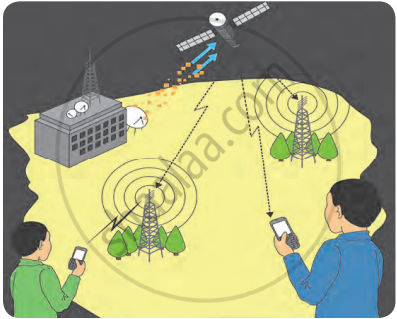
Communication by artificial satellite
Maharashtra State Board: Class 10
Indian Satellite Systems and Launch Vehicles
- INSAT (Indian National Satellite System) is used for communication, weather forecasting, and meteorology services across India.
- GSAT (Geosynchronous Satellite) is designed mainly for communication purposes, such as television broadcasting and internet services.
- IRNSS (Indian Regional Navigation Satellite System) is India’s own navigation system, similar to GPS, that provides accurate positioning within the country and nearby regions.
- IRS (Indian Remote Sensing Satellite) is used for Earth observation, including mapping, monitoring natural resources, and assessing environmental changes.
Launch Vehicles:
- GSLV (Geosynchronous Satellite Launch Vehicle) is used to launch heavier satellites into geosynchronous orbit.
- PSLV (Polar Satellite Launch Vehicle) is used to launch satellites into polar and low Earth orbits and is known for its reliability and cost-effectiveness.
Maharashtra State Board: Class 10
Definition: Artificial Satellite
If a manmade object revolves around the earth or any other planet in a fixed orbit it is called an artificial satellite.
Maharashtra State Board: Class 10
Key Points: Artificial Satellites
- Natural satellites are natural (like the Moon); artificial satellites are manmade and orbit planets.
- Sputnik was the first artificial satellite, launched by the USSR in 1957.
- Satellites use solar panels for energy and send/receive signals.
- Types of satellites: weather, communication, broadcast, navigation, military, and Earth observation.
- India uses INSAT, GSAT, IRNSS, and IRS satellites, launched by GSLV and PSLV rockets.
