- Replaced Circular Orbit Model: Before Kepler, people believed planets moved in perfect circles. His law proved this was wrong.
- Foundation of Celestial Mechanics: This law is the starting point for understanding how all objects orbit in space.
- Explains Planetary Motion: It explains why planets move at different speeds at different points in their orbits.
- Used in Space Missions: Scientists use this law to calculate spacecraft trajectories and orbital paths.
- Applies Beyond the Solar System: The same law applies to moons orbiting planets and even stars orbiting black holes.
- Predicts Planetary Positions: Astronomers use this law to predict where planets will be at any given time.
Topics
Gravitation
- Concept of Gravitation
- Force and Motion
- Circular Motion and Centripetal Force
- Kepler’s Laws
- Law of Orbit or Kepler's First Law
- Law of Areas or Kepler's Second Law
- Law of Periods or Kepler's Third Law
- Newton's Universal Law of Gravitation
- Uniform Circular Motion (UCM)
- Earth’s Gravitational Force
- Earth’s Gravitational Acceleration
- Mass and Weight
- Gravitational Waves
- Free Fall
- Gravitational Potential Energy
- Escape Velocity
- Weightlessness in Space
Periodic Classification of Elements
- Classification of Elements
- Dobereiner’s Triads
- Newland's Law of Octaves
- Mendeleev’s Periodic Table
- Insights into Mendeleev’s Periodic Table
- Modern Periodic Law
- Modern Periodic Table
- Structure of the Modern Periodic Table
- Modern Periodic Table and Electronic Configuration of Elements
- Groups and Electronic Configuration
- Periods and Electronic Configuration
- Periodic Trends in the Modern Periodic Table
- Atomic Size
- Metallic and Non-metallic Characters
- Gradation in Halogen Family
Chemical Reactions and Equations
- Chemical Reaction
- Chemical Equations
- Balancing Chemical Equation
- Types of Chemical Reactions > Combination Reaction
- Types of Chemical Reactions > Decomposition Reaction
- Types of Chemical Reactions > Single Displacement Reaction
- Types of Chemical Reactions > Double Displacement Reaction
- Endothermic and Exothermic Processes
- Rate of Chemical Reaction
- Types of Chemical Reactions > Oxidation and Reduction Reactions
- Corrosion of Metals
- Factors Affecting the Rate of a Chemical Reaction
- Rancidity
Effects of Electric Current
- Electric Circuit
- Heating Effect of Electric Current
- Magnetic Effect of Electric Current
- Right-hand Thumb Rule
- Applications of Biot-Savart's Law > Magnetic Field at the Axis of a Circular Current-carrying Loop
- Applications of Ampere’s Circuital Law > Magnetic Field of a Long Straight Solenoid
- Force on a Current-Carrying Conductor Placed in a Uniform Magnetic Field
- Fleming’s Left Hand Rule
- Electric Motor
- Introduction to Electromagnetic Induction
- Galvanometer
- Faraday's Laws of Electromagnetic Induction
- Fleming’s Right Hand Rule
- Alternating current (AC) and Direct Current (DC)
- Electric Generator
Heat
Refraction of Light
Lenses
- Concept of Lenses
- Images Formed by Convex Lenses
- Images Formed by Concave Lenses
- Sign Convention
- Lens Formula and Magnification
- Magnification
- Power of a Lens
- Combination of Lenses
- Human Eye
- Defects of Vision and Their Corrections > Myopia
- Defects of Vision and Their Corrections > Hypermetropia
- Defects of Vision and Their Corrections > Presbyopia
- Apparent Size of an Object
- Use of Concave Lenses
- Use of Convex Lenses
- Persistence of Vision
Metallurgy
- Physical Properties of Metal
- Physical Properties of Non-metal
- Chemical Properties of Metal
- Reactions of Metals
- Reactivity Series of Metals
- Chemical Properties of Non-metal
- Ionic Compounds
- Metallurgy
- Basic Principles of Metallurgy > Concentration of Ores
- Basic Principles of Metallurgy > Extraction of Metals
- Basic Principles of Metallurgy > Refining of Metals
- Corrosion of Metals
- Prevention of Corrosion
Carbon Compounds
- Bonds in Carbon Compounds
- Carbon: A Versatile Element
- Hydrocarbons
- Straight chains, Branched chains, and Rings of Carbon atoms
- Functional Groups in Carbon Compounds
- Nomenclature
- The IUPAC System of Nomenclature
- Homologous Series
- Chemical Properties of Carbon Compounds > Combustion
- Chemical Properties of Carbon Compounds > Oxidation
- Chemical Properties of Carbon Compounds > Addition Reaction
- Chemical Properties of Carbon Compounds > Substitution Reaction
- Ethanol
- Ethanoic Acid
- Macromolecules and Polymers
Space Missions
School of Elements
The Magic of Chemical Reactions
- Types of Chemical Reactions > Combination Reaction
- Types of Chemical Reactions > Decomposition Reaction
- Types of Chemical Reactions > Single Displacement Reaction
- Types of Chemical Reactions > Double Displacement Reaction
- Chemical Properties of Carbon Compounds > Oxidation
- Types of Double Displacement: Neutralization Reaction
The Acid Base Chemistry
The Electric Spark
All about Electromagnetism
- Magnetic force
- Bar Magnet and Solenoid Analogy
- Right-hand Thumb Rule
- Applications of Biot-Savart's Law > Magnetic Field at the Axis of a Circular Current-carrying Loop
- Applications of Ampere’s Circuital Law > Magnetic Field of a Long Straight Solenoid
- Force on a Current-Carrying Conductor Placed in a Uniform Magnetic Field
- Electric Motor
- Introduction to Electromagnetic Induction
- Alternating-Current Generator
- Simple D.C. Motor
- Household Electrical Circuits
Wonders of Light 1
Wonders of Light 2
Striving for better Environment 1
- Abatement of Pollution
- Sustainable Use of Resources
Estimated time: 11 minutes
Maharashtra State Board: Class 11
Introduction
Kepler's First Law describes how planets move in space around the Sun. This law tells us that planets do not orbit in perfect circles as once believed. Instead, all planets follow an elliptical path with the Sun positioned at one of the two special points (called foci) of the ellipse. This discovery changed our understanding of the solar system forever. It forms the foundation of modern planetary motion and orbital mechanics.
Maharashtra State Board: Class 11
Characteristics
- All planetary orbits are elliptical in shape, not circular
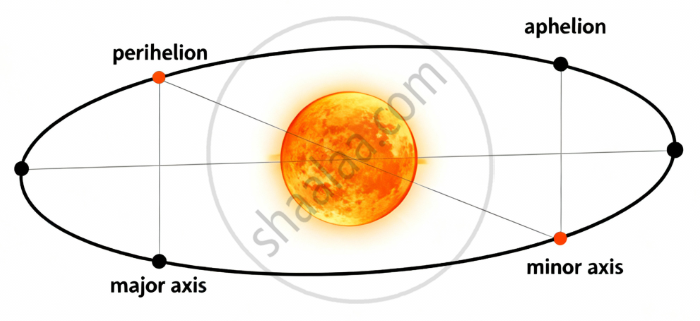
- The Sun is always at one focus (S) of the ellipse, not at the center
- The second focus (S') is always empty
- Perihelion is the nearest point; Aphelion is the farthest point
- The major axis connects perihelion and aphelion through both foci
- The distance between the two foci varies for different planets
- Planets with nearly circular orbits have foci very close together
- Planets with more stretched orbits have foci farther apart
CBSE: Class 12
Maharashtra State Board: Class 10, 11
Maharashtra State Board: Class 10, 11
Law: Kepler's First Law
Kepler's First Law (Law of Ellipses)
- Each planet moves in an elliptical orbit with the Sun at one focus.
- This means planetary orbits are stretched circles, not perfect circles.
- The ellipse has two foci; the Sun occupies one of these.
Maharashtra State Board: Class 11
Key Terms: Law of Orbit or Kepler's First Law
Ellipse: A closed oval shape with two special points called foci.
Focus (Foci): The two fixed points inside an ellipse. One focus contains the Sun, while the other is empty.
Perihelion (P): The closest point along a planet's orbit from the Sun.
Aphelion (A): The farthest point along a planet's orbit from the Sun.
Major Axis (PA): The longest diameter of the ellipse = 2a
Semi-major Axis (PO or AO): Half of the major axis = a
Minor Axis (MN): The shortest diameter of the ellipse = 2b
Semi-minor Axis (MO or ON): Half of the minor axis = b
Maharashtra State Board: Class 11
Understanding Elliptical Orbit
Perihelion (Closest Point):
- This is where the planet comes nearest to the Sun
- The planet moves fastest at this point (due to stronger gravitational pull)
- Example: Earth's perihelion occurs around January 3rd each year
Aphelion (Farthest Point):
- This is where the planet is farthest from the Sun
- The planet moves slowest at this point (gravitational force is weakest)
- Example: Earth's aphelion occurs around July 4th each year
Maharashtra State Board: Class 11
Significance
Maharashtra State Board: Class 11
Real-Life Examples
- Earth’s orbit is almost circular, closest in January (147.1M km) and farthest in July (152.1M km).
- Mercury’s Orbit – Very elliptical; ranges from 46M to 70M km from the Sun.
- Moon’s Orbit – Elliptical; appears bigger at perigee (Supermoon) and smaller at apogee.
- ISS Orbit – Slightly elliptical; speed is controlled to keep it stable.
