Topics
Gravitation
- Concept of Gravitation
- Force and Motion
- Circular Motion and Centripetal Force
- Kepler’s Laws
- Law of Orbit or Kepler's First Law
- Law of Areas or Kepler's Second Law
- Law of Periods or Kepler's Third Law
- Newton's Universal Law of Gravitation
- Uniform Circular Motion (UCM)
- Earth’s Gravitational Force
- Earth’s Gravitational Acceleration
- Mass and Weight
- Gravitational Waves
- Free Fall
- Gravitational Potential Energy
- Escape Velocity
- Weightlessness in Space
Periodic Classification of Elements
- Classification of Elements
- Dobereiner’s Triads
- Newland's Law of Octaves
- Mendeleev’s Periodic Table
- Insights into Mendeleev’s Periodic Table
- Modern Periodic Law
- Modern Periodic Table
- Structure of the Modern Periodic Table
- Modern Periodic Table and Electronic Configuration of Elements
- Groups and Electronic Configuration
- Periods and Electronic Configuration
- Periodic Trends in the Modern Periodic Table
- Atomic Size
- Metallic and Non-metallic Characters
- Gradation in Halogen Family
Chemical Reactions and Equations
- Chemical Reaction
- Chemical Equations
- Balancing Chemical Equation
- Types of Chemical Reactions > Combination Reaction
- Types of Chemical Reactions > Decomposition Reaction
- Types of Chemical Reactions > Single Displacement Reaction
- Types of Chemical Reactions > Double Displacement Reaction
- Endothermic and Exothermic Processes
- Rate of Chemical Reaction
- Types of Chemical Reactions > Oxidation and Reduction Reactions
- Corrosion of Metals
- Factors Affecting the Rate of a Chemical Reaction
- Rancidity
Effects of Electric Current
- Electric Circuit
- Heating Effect of Electric Current
- Magnetic Effect of Electric Current
- Right-hand Thumb Rule
- Applications of Biot-Savart's Law > Magnetic Field at the Axis of a Circular Current-carrying Loop
- Applications of Ampere’s Circuital Law > Magnetic Field of a Long Straight Solenoid
- Force on a Current-Carrying Conductor Placed in a Uniform Magnetic Field
- Fleming’s Left Hand Rule
- Electric Motor
- Introduction to Electromagnetic Induction
- Galvanometer
- Faraday's Laws of Electromagnetic Induction
- Fleming’s Right Hand Rule
- Alternating current (AC) and Direct Current (DC)
- Electric Generator
Heat
Refraction of Light
Lenses
- Concept of Lenses
- Images Formed by Convex Lenses
- Images Formed by Concave Lenses
- Sign Convention
- Lens Formula and Magnification
- Magnification
- Power of a Lens
- Combination of Lenses
- Human Eye
- Defects of Vision and Their Corrections > Myopia
- Defects of Vision and Their Corrections > Hypermetropia
- Defects of Vision and Their Corrections > Presbyopia
- Apparent Size of an Object
- Use of Concave Lenses
- Use of Convex Lenses
- Persistence of Vision
Metallurgy
- Physical Properties of Metal
- Physical Properties of Non-metal
- Chemical Properties of Metal
- Reactions of Metals
- Reactivity Series of Metals
- Chemical Properties of Non-metal
- Ionic Compounds
- Metallurgy
- Basic Principles of Metallurgy > Concentration of Ores
- Basic Principles of Metallurgy > Extraction of Metals
- Basic Principles of Metallurgy > Refining of Metals
- Corrosion of Metals
- Prevention of Corrosion
Carbon Compounds
- Bonds in Carbon Compounds
- Carbon: A Versatile Element
- Hydrocarbons
- Straight chains, Branched chains, and Rings of Carbon atoms
- Functional Groups in Carbon Compounds
- Nomenclature
- The IUPAC System of Nomenclature
- Homologous Series
- Chemical Properties of Carbon Compounds > Combustion
- Chemical Properties of Carbon Compounds > Oxidation
- Chemical Properties of Carbon Compounds > Addition Reaction
- Chemical Properties of Carbon Compounds > Substitution Reaction
- Ethanol
- Ethanoic Acid
- Macromolecules and Polymers
Space Missions
School of Elements
The Magic of Chemical Reactions
- Types of Chemical Reactions > Combination Reaction
- Types of Chemical Reactions > Decomposition Reaction
- Types of Chemical Reactions > Single Displacement Reaction
- Types of Chemical Reactions > Double Displacement Reaction
- Chemical Properties of Carbon Compounds > Oxidation
- Types of Double Displacement: Neutralization Reaction
The Acid Base Chemistry
The Electric Spark
All about Electromagnetism
- Magnetic force
- Bar Magnet and Solenoid Analogy
- Right-hand Thumb Rule
- Applications of Biot-Savart's Law > Magnetic Field at the Axis of a Circular Current-carrying Loop
- Applications of Ampere’s Circuital Law > Magnetic Field of a Long Straight Solenoid
- Force on a Current-Carrying Conductor Placed in a Uniform Magnetic Field
- Electric Motor
- Introduction to Electromagnetic Induction
- Alternating-Current Generator
- Simple D.C. Motor
- Household Electrical Circuits
Wonders of Light 1
Wonders of Light 2
Striving for better Environment 1
- Abatement of Pollution
- Sustainable Use of Resources
Definition: Acceleration Due to Gravity
The gravitational force due to the earth on a body results in its acceleration. This is called acceleration due to gravity and is denoted by ‘g’. Acceleration is a vector.
Introduction:
Gravitational force is the force that the Earth uses to pull all objects toward itself. This is why when something is thrown upward, it eventually falls back down to the ground.
- For example, when a ball is thrown up, it reaches a certain height and then comes back down because of the Earth's gravitational pull.
- The stronger the gravitational force on an object, the harder it is to lift.
- Gravitational force also works in space. It keeps the planets in the solar system revolving around the sun.
- Gravity also acts between planets and their moons, keeping the moons in orbit around the planets.
Discovery of Gravitational Force:
In the 17th century, Sir Isaac Newton discovered the concept of gravitation. The earth’s gravitational force acts in a direction opposite to that of an object moving upwards. Hence, the speed of that object goes on decreasing till, in the end, it becomes zero. Then the object starts falling down instead of going up any further. While falling, its speed goes on increasing all the time due to gravitational force.
Earth’s Gravitational Force:
The Earth attracts all objects towards its centre due to gravitational force. The centre of mass of the Earth is at its geometric centre, so the gravitational force on any object is always directed toward the centre of the Earth.
- This force causes objects to fall vertically downward when dropped.
- When a stone is thrown upwards, gravity pulls it down, gradually reducing its velocity. Eventually, the velocity becomes zero, and the stone starts falling back due to Earth's pull.
Gravitational Force and the Moon/Satellites:
- The Earth’s gravity also acts on the Moon and artificial satellites, keeping them in orbit.
- Unlike a falling object, the Moon and satellites do not crash into Earth because they have a forward velocity along their orbits.
- If this velocity did not exist, they would fall directly onto Earth, just like an apple falling from a tree.
Thus, the balance between Earth’s gravitational pull and the orbital velocity keeps the Moon and satellites in continuous motion around Earth.
Experiment:
1. Aim: To observe the difference in sound when a stone is dropped from different heights and understand the effect of gravitational force on objects of different weights. Effect of Height and Weight on Gravitational Force.
2. Requirements: A small stone, a bucket of water, and two sacks (one empty, one full)
3. Procedure
I. Stone experiment:
- Take a small stone and a bucket of water.
- Drop the stone into the water from a height of about 20 cm.
- Observe and listen to the sound made when the stone hits the water.
- Now, drop the same stone into the water from a height of about 100 cm.
- Again, observe and listen to the sound produced.
II. Sack experiment:
- Take two sacks—one empty and the other full.
- Lift the empty sack and notice how much effort is needed.
- Then, lift the full sack and observe the difference in the effort required.
4. Conclusion:
- For the stone experiment: Dropping the stone from a greater height produces a louder sound because the stone gains more speed as it falls due to the effect of gravitational force. This means that the greater the height, the more speed and force the stone has when it hits the water.
- For the sack experiment: The empty sack is easier to lift because it weighs less, meaning the gravitational force acting on it is smaller. The full sack requires more effort to lift because it is heavier, and the gravitational force on it is greater. This shows that greater force is needed to lift heavier objects.
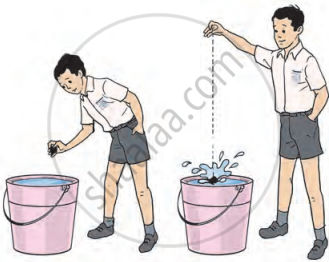
Dropping a stone in water
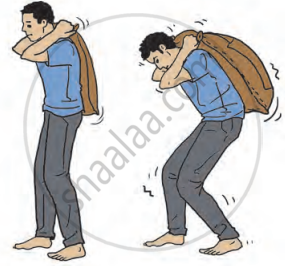
Carrying a load
