Advertisements
Advertisements
Question
Observe the given figure and answer the following questions.
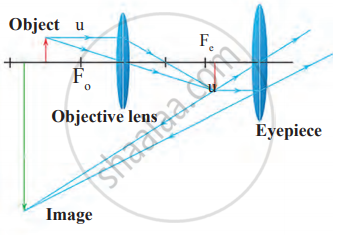
- Where is the above type of lens construction used?
- What type of image is formed by an objective lens?
- What happens instead of placing at Fo if the object is placed in between O and Fo?
Advertisements
Solution
- The above type of lens construction is used in a compound microscope.
- The image formed by the objective is real, inverted, and formed at a distance within the focal length of the eyepiece.
- If the object is placed in between O and Fo, a virtual image will be formed on the same side of the objective as that of the object. As a result, compound microscope will not be able to operate as expected.
APPEARS IN
RELATED QUESTIONS
(a) Draw a ray diagram to show the formation of an image by a convex lens when an object is placed in front of the lens between its optical centre and principal focus.
(b) In the above ray diagram, mark the object distance (u) and the image distance (v) with their proper signs (+ve or –ve as per the new Cartesian sign convention) and state how these distances are related to the focal length (f) of the convex lens in this case.
(c) Find the power of a convex lens which forms a real and inverted image of magnification –1 of an object placed at a distance of 20 cm from its optical centre.
"A lens can form a magnified erect image as well as magnified inverted image of an object placed in front of it." State the nature of this lens and draw ray diagrams to justify the above statement. Mark the positions of O, F and 2F in the diagram.
When a ray of light enters from one medium to another having different optical densities it bends. Why does this phenomenon occur?
Draw a labelled ray diagram to show how a ray of light is refracted when it passes:
from air into an optically denser medium.
Where should an object be placed in order to use a convex lens as a magnifying glass?
Where should an object be placed in front of a convex lens so as to obtain its virtual, erect and magnified image?
Define the principal axis of a convex lens.
An object is placed at a distance equal to 2f in front of a convex lens. Draw a labelled ray diagram to show the formation of image. State two characteristics of the image formed.
With the help of a labelled diagram explain how a convex lens converges a beam of parallel light rays. Mark the principal axis, optical centre, principal focus and focal length of the convex lens on the diagram.
Name one simple optical instrument in which the above arrangement of convex lens is used.
A student did an experiment with a convex lens. He put an object at different distances 25 cm, 30 cm, 40 cm, 60 cm and 120 cm from the lens. In each case he measured the distance of the image from the lens. His results were 100 cm, 24 cm, 60 cm, 30 cm and 40 cm, respectively. Unfortunately his results are written in wrong order.
Which of the object distances gives the biggest image?
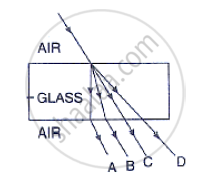
In figure , name the ray which represents the correct path of light while emerging out through
a glass block.
A lens forms an erect, magnified, and virtual image of an object.
- Name the type of lens.
- Draw a ray diagram to show the formation of the image.
- Where is the object placed in relation to the lens?
- Name the device which uses this principle.
A convex lens forms an image of an object equal to the size of the object. Draw a diagram to illustrate it.
A student places a 8.0 cm tall object perpendicular to the principal axis of a convex lens of focal length 20 cm. The distance of the object from the lens is 30 cm. He obtains a sharp image of the object on a screen placed on the other side of the lens. What will be the nature (inverted, erect, magnified, diminished) of the image he obtains on a screen? Draw ray diagram to justify your answer.
What is the difference between a double convex and a bi-convex lens?
Out of the two lenses one concave and the other convex state which is a convergent or a divergent type of a lens. Give a reason for your answer.
State the nature and position of the object on the principal axis to obtain a real image of the same size
Find the odd one out and give its explanation.
