Advertisements
Advertisements
प्रश्न
If an object is placed in front of a convex lens beyond 2F1, then what will be the position, relative size, and nature of an image which is formed? Explain with a ray diagram.
Advertisements
उत्तर

APPEARS IN
संबंधित प्रश्न
A student wants to project the image of a candle flame on the walls of school laboratory by using a lens:-
(a) Which type of lens should be use and why?
(b) At what distance in terms of focal length 'F' of the lens should be place the candle flame so as to get (i) a magnified, and (ii) a diminished image respectively on the wall?
(c) Draw ray diagram to show the formation of the image in each case?
An object is placed at a distance of 15 cm from a concave lens of focal length 30 cm. List four characteristics (nature, position, etc.) of the image formed by the lens.
Where should an object be placed so that a real and inverted image of the same size as the object is obtained using a convex lens?
A ray of light travelling in water emerges into air. Draw a ray-diagram indicating the change in its path.
Draw a labelled ray diagram to show how a ray of light is refracted when it passes:
from air into an optically denser medium.
Draw a labelled ray diagram to show the angle of incidence and the angle of refraction for a refracted ray of light.
Draw a ray diagram to show the formation of a real magnified image by a convex lens. (In your sketch the position of object and image with respect to the principal focus of lens should be shown clearly).
Find the nature, position and magnification of the images formed by a convex lens of focal length 0.20 m if the object is placed at a distance of:
0.15 m
A student did an experiment with a convex lens. He put an object at different distances 25 cm, 30 cm, 40 cm, 60 cm and 120 cm from the lens. In each case he measured the distance of the image from the lens. His results were 100 cm, 24 cm, 60 cm, 30 cm and 40 cm, respectively. Unfortunately his results are written in wrong order.
- Rewrite the image distances in the correct order.
- What would be the image distance if the object distance was 90 cm?
- Which of the object distances gives the biggest image?
- What is the focal length of this lens?
Draw a diagram to represent the second focus of a convex lens.
Where is the image formed?
A lens forms an erect, magnified, and virtual image of an object.
- Name the type of lens.
- Draw a ray diagram to show the formation of the image.
- Where is the object placed in relation to the lens?
- Name the device which uses this principle.
The given below figure shows an object OA and its image IB formed by a lens
. 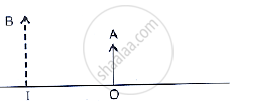
draw suitable rays to locate the lens and its focus.
When you focus the image of a distant flag, whose shape is given below, on a screen using a convex lens, the shape of the image as it appears on the screen is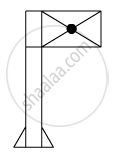
(A)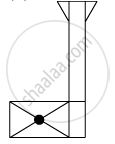
(B)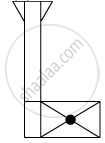
(C)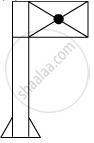
(D)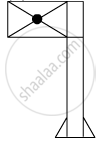
While determining the focal length of a convex lens, you try to focus the image of a distant object formed by the lens on the screen. The image formed on the screen, as compared to the object, should be
(A) erect and highly diminished
(B) erect and enlarged
(C) inverted and enlarged
(D) inverted and highly diminished
A student places a 8.0 cm tall object perpendicular to the principal axis of a convex lens of focal length 20 cm. The distance of the object from the lens is 30 cm. He obtains a sharp image of the object on a screen placed on the other side of the lens. What will be the nature (inverted, erect, magnified, diminished) of the image he obtains on a screen? Draw ray diagram to justify your answer.
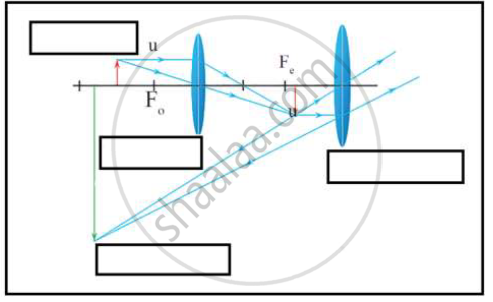
i. Which type of microscope has the arrangement of lenses shown in the adjoining figure?
ii. Label the figure correctly.
iii. Write the working of this microscope.
iv. Where does this microscope used?
v. Suggest a way to increase the efficiency of this microscope.
State the position of object, position of image, nature of image when: Convex lens is used in observing biological specimens.
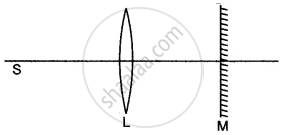
In the figure given below L is a convex lens, M is a plane mirror and S is a point source of light. Rays of light from the source S return to their point of origin. Complete the ray diagram to show this. What is the point S called?