Advertisements
Advertisements
प्रश्न
Explain: ‘How is a rainbow formed’?
Advertisements
उत्तर

1. The beautiful phenomenon of the rainbow is a combination of different phenomena – dispersion, refraction, and reflection of light.
2. The rainbow appears in the sky after a rain shower.
3. The water droplets act as small prisms.
4. When sunlight enters the water droplets present in the atmosphere, they refract and disperse the incident sunlight.
5. Then they reflect it internally inside the droplet and finally again refract it.
6. As a collective effect of all these phenomena, the seven-colored rainbows are observed.
APPEARS IN
संबंधित प्रश्न
Give a scientific reason:
Danger signal lights are red in colour.
Show with the help of a diagram, how unpolarised light from Sun gets linearly polarised by scattering.
In the meterbridge experimental set up, shown in the figure, the null point ‘D’ is obtained at a distance of 40 cm from end A of the meterbridge wire. If a resistance of 10Ω is connected in series with R1, null point is obtained at AD = 60 cm. Calculate the values of R1 and R2.
What is linearly polarized light?
Describe briefly using a diagram how sunlight is polarised ?
A convex lens is made of a material having refractive index
\[1 \cdot 2\] Both the surfaces of the lens are convex. If it is dipped into water (μ = 1.33), it will behave like
A point object O is placed on the principal axis of a convex lens of focal length f = 20 cm at a distance of 40 cm to the left of it. The diameter of the lens is 10 cm. An eye is placed 60 cm to right of the lens and a distance h below the principal axis. The maximum value of h to see the image is
An optical fibre (μ = 1.72) is surrounded by a glass coating (μ = 1.50). Find the critical angle for total internal reflection at the fibre-glass interface.
Light falls from glass (μ = 1.5) to air. Find the angle of incidence for which the angle of deviation is 90°.
A point source is placed at a depth h below the surface of water (refractive index = μ). (a) Show that light escapes through a circular area on the water surface with its centre directly above the point source. (b) Find the angle subtended by a radius of the area on the source.
A container contains water up to a height of 20 cm and there is a point source at the centre of the bottom of the container. A rubber ring of radius r floats centrally on the water. The ceiling of the room is 2.0 m above the water surface.
- Find the radius of the shadow of the ring formed on the ceiling if r = 15 cm.
- Find the maximum value of r for which the shadow of the ring is formed on the ceiling. Refractive index of water = `4/3`.
A paperweight in the form of a hemisphere of radius 3.0 cm is used to hold down a printed page. An observer looks at the page vertically through the paperweight. At what height above the page will the printed letters near the centre appear to the observer?
The diameter of the sun is 1.4 × 10⁹ m and its distance from the earth is 1.5 × 10¹¹ m. Find the radius of the image of the sun formed by a lens of focal length 20 cm.
Answer the following question in detail.
Is it possible to see primary and secondary rainbow simultaneously? Under what conditions?
Pick the wrong answer in the context with rainbow.
Rainbow is the phenomenon due to ______.
| Case study: Mirage in deserts |
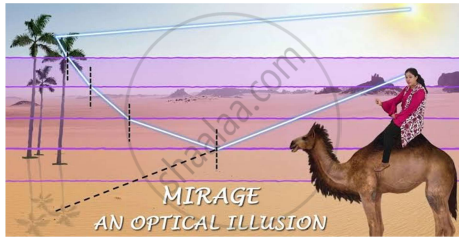 |
|
To a distant observer, the light appears to be coming from somewhere below the ground. The observer naturally assumes that light is being reflected from the ground, say, by a pool of water near the tall object. Such inverted images of distant tall objects cause an optical illusion to the observer. This phenomenon is called mirage. This type of mirage is especially common in hot deserts. Based on the above facts, answer the following question: |
Which of the following phenomena is prominently involved in the formation of mirage in deserts?
| Case study: Mirage in deserts |
|
|
To a distant observer, the light appears to be coming from somewhere below the ground. The observer naturally assumes that light is being reflected from the ground, say, by a pool of water near the tall object. Such inverted images of distant tall objects cause an optical illusion to the observer. This phenomenon is called mirage. This type of mirage is especially common in hot deserts. Based on the above facts, answer the following question: |
A diamond is immersed in such a liquid which has its refractive index with respect to air as greater than the refractive index of water with respect to air. Then the critical angle of diamond-liquid interface as compared to critical angle of diamond-water interface will
