Advertisements
Advertisements
प्रश्न
Explain: ‘How is a rainbow formed’?
Advertisements
उत्तर

1. The beautiful phenomenon of the rainbow is a combination of different phenomena – dispersion, refraction, and reflection of light.
2. The rainbow appears in the sky after a rain shower.
3. The water droplets act as small prisms.
4. When sunlight enters the water droplets present in the atmosphere, they refract and disperse the incident sunlight.
5. Then they reflect it internally inside the droplet and finally again refract it.
6. As a collective effect of all these phenomena, the seven-colored rainbows are observed.
APPEARS IN
संबंधित प्रश्न
Draw the intensity distribution for the diffraction bands produced due to single slit ?
What is linearly polarized light?
A concave mirror having a radius of curvature 40 cm is placed in front of an illuminated point source at a distance of 30 cm from it. Find the location of the image.
A 3 cm tall object is placed at a distance of 7.5 cm from a convex mirror of focal length 6 cm. Find the location, size and nature of the image.
A point source S is placed midway between two converging mirrors having equal focal length f as shown in figure. Find the values of d for which only one image is formed.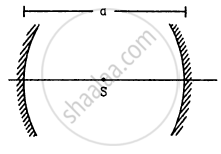
Light is incident from glass (μ = 1.50) to water (μ = 1.33). Find the range of the angle of deviation for which there are two angles of incidence.
Light falls from glass (μ = 1.5) to air. Find the angle of incidence for which the angle of deviation is 90°.
A container contains water up to a height of 20 cm and there is a point source at the centre of the bottom of the container. A rubber ring of radius r floats centrally on the water. The ceiling of the room is 2.0 m above the water surface.
- Find the radius of the shadow of the ring formed on the ceiling if r = 15 cm.
- Find the maximum value of r for which the shadow of the ring is formed on the ceiling. Refractive index of water = `4/3`.
A biconvex thick lens is constructed with glass (μ = 1.50). Each of the surfaces has a radius of 10 cm and the thickness at the middle is 5 cm. Locate the image of an object placed far away from the lens.
One end of a cylindrical glass rod (μ = 1.5) of radius 1.0 cm is rounded in the shape of a hemisphere. The rod is immersed in water (μ = 4/3) and an object is placed in the water along the axis of the rod at a distance of 8.0 cm from the rounded edge. Locate the image of the object.
Fill in the blank and rewrite the completed statement:
Very fine particles mainly scatter ______ light.
Answer the following question in detail.
State the conditions under which a rainbow can be seen.
Answer the following question in detail.
Explain the formation of a primary rainbow. For which angular range with the horizontal is it visible?
Answer the following question in detail.
Explain the formation of a secondary rainbow. For which angular range with the horizontal is it visible?
A parallel beam of light of wavelength 5890 Å falls normally on a slit of width 0.2 mm. Find the distance between the first minima on the two sides of the central maximum of the diffraction pattern observed on a screen placed in the focal plane of a convex lens of focal length 50 cm. The lens is placed quite close to the slit.
| Case study: Mirage in deserts |
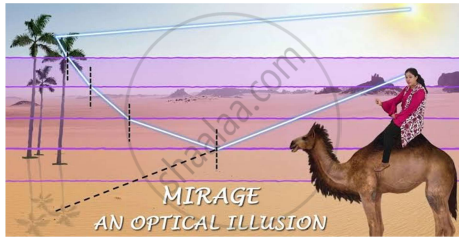 |
|
To a distant observer, the light appears to be coming from somewhere below the ground. The observer naturally assumes that light is being reflected from the ground, say, by a pool of water near the tall object. Such inverted images of distant tall objects cause an optical illusion to the observer. This phenomenon is called mirage. This type of mirage is especially common in hot deserts. Based on the above facts, answer the following question: |
The following figure shows a cross-section of a ‘light pipe’ made of a glass fiber of refractive index 1.68. The outer covering of the pipe is made of a material of refractive index 1.44. What is the range of the angles of the incident rays with the axis of the pipe for the following phenomena to occur.
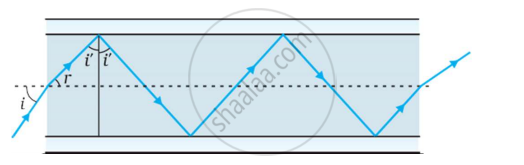
The sky would appear red instead of blue if
A short pulse of white light is incident from air to a glass slab at normal incidence. After travelling through the slab, the first colour to emerge is ______.
A passenger in an aeroplane shall ______.
Between the primary and secondary rainbows, there is a dark band known as Alexandar’s dark band. This is because ______.
- light scattered into this region interfere destructively.
- there is no light scattered into this region.
- light is absorbed in this region.
- angle made at the eye by the scattered rays with respect to the incident light of the sun lies between approximately 42° and 50°.
