मराठी
कर्नाटक बोर्ड पी.यू.सी.पीयूसी विज्ञान इयत्ता ११

A Concave Mirror Having a Radius of Curvature 40 Cm is Placed in Front of an Illuminated Point Source at a Distance of 30 Cm from It. Find the Location of the Image. - Physics

Advertisements
Advertisements

प्रश्न

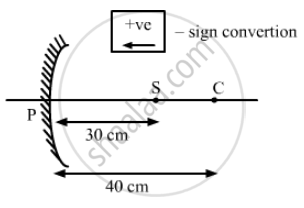
A concave mirror having a radius of curvature 40 cm is placed in front of an illuminated point source at a distance of 30 cm from it. Find the location of the image.

बेरीज
Advertisements

उत्तर

Using sign conventions, given,
Distance of object from mirror, u = − 30 cm,
Radius of curvature of concave mirror R = − 40 cm
Using the mirror equation,

\[\frac{1}{v} + \frac{1}{u} = \frac{2}{R}\] 

\[ \Rightarrow   \frac{1}{v} = \frac{2}{R} - \frac{1}{u}\] 

\[ \Rightarrow \frac{1}{v} = \frac{2}{- 40} - \frac{1}{- 30} = \frac{1}{- 20} + \frac{1}{30}\] 

\[ \Rightarrow \frac{1}{v} = \frac{- 30 + 20}{30 \times 20} = \frac{- 10}{30 \times 20}\] 

\[ \Rightarrow \frac{1}{v} =  - \frac{1}{60}\]

or, v = − 60 cm
Hence, the required image will be located at a distance of 60 cm in front of the concave mirror.

shaalaa.com
  या प्रश्नात किंवा उत्तरात काही त्रुटी आहे का?
पाठ 18: Geometrical Optics - Exercise [पृष्ठ ४१२]

APPEARS IN

एचसी वर्मा Concepts of Physics Vol. 1 [English] Class 11 and 12
पाठ 18 Geometrical Optics
Exercise | Q 1 | पृष्ठ ४१२

संबंधित प्रश्‍न

Give a scientific reason:

Danger signals are red in colour.


Fill in the blank:

Very fine particles mainly scatter ………… colored light.


Why does the Sun look reddish at sunset or sunrise ?


In the meterbridge experimental set up, shown in the figure, the null point ‘D’ is obtained at a distance of 40 cm from end A of the meterbridge wire. If a resistance of 10Ω is connected in series with R1, null point is obtained at AD = 60 cm. Calculate the values of R1 and R2.


The image formed by a concave mirror


A 1 cm object is placed perpendicular to the principal axis of a convex mirror of focal length 7.5 cm. Find its distance from the mirror if the image formed is 0.6 cm in size.


Locate the image of the point P as seen by the eye in the figure.


Light falls from glass (μ = 1.5) to air. Find the angle of incidence for which the angle of deviation is 90°.


A biconvex thick lens is constructed with glass (μ = 1.50). Each of the surfaces has a radius of 10 cm and the thickness at the middle is 5 cm. Locate the image of an object placed far away from the lens.


The diameter of the sun is 1.4 × 10⁹ m and its distance from the earth is 1.5 × 10¹¹ m. Find the radius of the image of the sun formed by a lens of focal length 20 cm.


Answer the following question in detail.

Explain the formation of a primary rainbow. For which angular range with the horizontal is it visible?


Answer the following question in detail.

Is it possible to see primary and secondary rainbow simultaneously? Under what conditions?


Case study: Mirage in deserts 

To a distant observer, the light appears to be coming from somewhere below the ground. The observer naturally assumes that light is being reflected from the ground, say, by a pool of water near the tall object.

Such inverted images of distant tall objects cause an optical illusion to the observer. This phenomenon is called mirage. This type of mirage is especially common in hot deserts.

Based on the above facts, answer the following question:

Which of the following phenomena is prominently involved in the formation of mirage in deserts?


Case study: Mirage in deserts 

To a distant observer, the light appears to be coming from somewhere below the ground. The observer naturally assumes that light is being reflected from the ground, say, by a pool of water near the tall object.

Such inverted images of distant tall objects cause an optical illusion to the observer. This phenomenon is called mirage. This type of mirage is especially common in hot deserts.

Based on the above facts, answer the following question:

A diamond is immersed in such a liquid which has its refractive index with respect to air as greater than the refractive index of water with respect to air. Then the critical angle of diamond-liquid interface as compared to critical angle of diamond-water interface will


Case study: Mirage in deserts

To a distant observer, the light appears to be coming from somewhere below the ground. The observer naturally assumes that light is being reflected from the ground, say, by a pool of water near the tall object.

Such inverted images of distant tall objects cause an optical illusion to the observer. This phenomenon is called mirage. This type of mirage is especially common in hot deserts.

Based on the above facts, answer the following question:

The following figure shows a cross-section of a ‘light pipe’ made of a glass fiber of refractive index 1.68. The outer covering of the pipe is made of a material of refractive index 1.44. What is the range of the angles of the incident rays with the axis of the pipe for the following phenomena to occur.


A short pulse of white light is incident from air to a glass slab at normal incidence. After travelling through the slab, the first colour to emerge is ______.


Between the primary and secondary rainbows, there is a dark band known as Alexandar’s dark band. This is because ______.

  1. light scattered into this region interfere destructively.
  2. there is no light scattered into this region.
  3. light is absorbed in this region.
  4. angle made at the eye by the scattered rays with respect to the incident light of the sun lies between approximately 42° and 50°.

Share
Notifications

Englishहिंदीमराठी


      Forgot password?
Use app×