Advertisements
Advertisements
प्रश्न
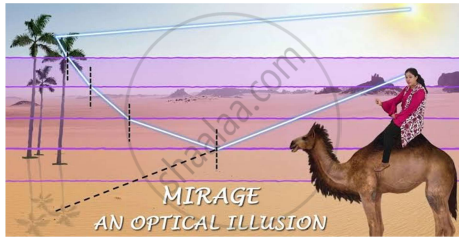
| Case study: Mirage in deserts |
![]() |
|
To a distant observer, the light appears to be coming from somewhere below the ground. The observer naturally assumes that light is being reflected from the ground, say, by a pool of water near the tall object. Such inverted images of distant tall objects cause an optical illusion to the observer. This phenomenon is called mirage. This type of mirage is especially common in hot deserts. Based on the above facts, answer the following question: |
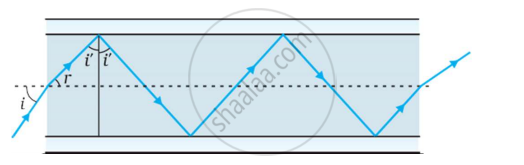
The following figure shows a cross-section of a ‘light pipe’ made of a glass fiber of refractive index 1.68. The outer covering of the pipe is made of a material of refractive index 1.44. What is the range of the angles of the incident rays with the axis of the pipe for the following phenomena to occur.
पर्याय
0 < i < 90°
0 < i < 60°
0 < i < 45°
0 < i < 30°
Advertisements
उत्तर
0 < i < 60°
Explanation -
`1_(mu_2) = 1/(Sin "C'")`
Sin C' = `1.44/1.68` = 0.8571
C' ⇒ 59°
Total internal reflection will occur if the angle `"i'" > "i"_"c"^"'"`,
i.e., if i' > 59° or when r < rmax’ where rmax = 90° – 59° = 31°.
Using Snell’s law,
`("Sin" "i"_"max")/("Sin" "r"_"max")` = 1.68
or Sin imax = 1.68 × Sin rmax
= 1.68 × sin 31°
= 1.68 × 0.5150
= 0.8662
∴ imax = 60°
Thus all incident rays which make angles in the range 0 < i < 60° with the axis of the pipe will suffer total internal reflections in the pipe.
APPEARS IN
संबंधित प्रश्न
Why can’t we see clearly through fog?
Why does unpolarised light from a source show a variation in intensity when viewed through a polaroid which is rotated?
Suppose you are inside the water in a swimming pool near an edge. A friends is standing on the edge. Do you find your friend taller or shorter than his usual height?
A parallel beam of light is incident on a converging lens parallel to its principal axis. As one moves away from the lens on the other side on its principal axis, the intensity of light
A point source S is placed midway between two converging mirrors having equal focal length f as shown in figure. Find the values of d for which only one image is formed.
Light falls from glass (μ = 1.5) to air. Find the angle of incidence for which the angle of deviation is 90°.
One end of a cylindrical glass rod (μ = 1.5) of radius 1.0 cm is rounded in the shape of a hemisphere. The rod is immersed in water (μ = 4/3) and an object is placed in the water along the axis of the rod at a distance of 8.0 cm from the rounded edge. Locate the image of the object.
Fill in the blank and rewrite the completed statement:
Very fine particles mainly scatter ______ light.
Answer the following question in detail.
State the conditions under which a rainbow can be seen.
| Case study: Mirage in deserts |
![]() |
|
To a distant observer, the light appears to be coming from somewhere below the ground. The observer naturally assumes that light is being reflected from the ground, say, by a pool of water near the tall object. Such inverted images of distant tall objects cause an optical illusion to the observer. This phenomenon is called mirage. This type of mirage is especially common in hot deserts. Based on the above facts, answer the following question : |
A diver at a depth 12 m inside water `(a_(µω) = 4/3)` sees the sky in a cone of semi-vertical angle


