Advertisements
Advertisements
Question
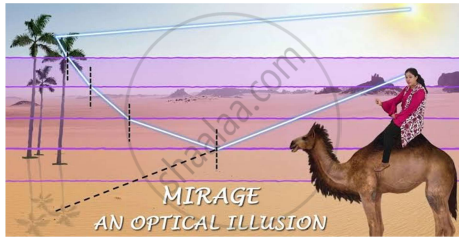
| Case study: Mirage in deserts |
![]() |
|
To a distant observer, the light appears to be coming from somewhere below the ground. The observer naturally assumes that light is being reflected from the ground, say, by a pool of water near the tall object. Such inverted images of distant tall objects cause an optical illusion to the observer. This phenomenon is called mirage. This type of mirage is especially common in hot deserts. Based on the above facts, answer the following question: |
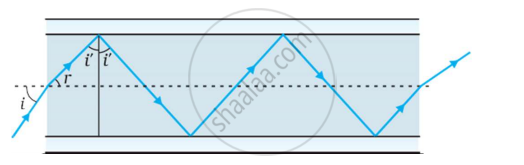
The following figure shows a cross-section of a ‘light pipe’ made of a glass fiber of refractive index 1.68. The outer covering of the pipe is made of a material of refractive index 1.44. What is the range of the angles of the incident rays with the axis of the pipe for the following phenomena to occur.
Options
0 < i < 90°
0 < i < 60°
0 < i < 45°
0 < i < 30°
Advertisements
Solution
0 < i < 60°
Explanation -
`1_(mu_2) = 1/(Sin "C'")`
Sin C' = `1.44/1.68` = 0.8571
C' ⇒ 59°
Total internal reflection will occur if the angle `"i'" > "i"_"c"^"'"`,
i.e., if i' > 59° or when r < rmax’ where rmax = 90° – 59° = 31°.
Using Snell’s law,
`("Sin" "i"_"max")/("Sin" "r"_"max")` = 1.68
or Sin imax = 1.68 × Sin rmax
= 1.68 × sin 31°
= 1.68 × 0.5150
= 0.8662
∴ imax = 60°
Thus all incident rays which make angles in the range 0 < i < 60° with the axis of the pipe will suffer total internal reflections in the pipe.
APPEARS IN
RELATED QUESTIONS
Show with the help of a diagram, how unpolarised light from Sun gets linearly polarised by scattering.
Describe briefly using a diagram how sunlight is polarised ?
A point object O is placed on the principal axis of a convex lens of focal length f = 20 cm at a distance of 40 cm to the left of it. The diameter of the lens is 10 cm. An eye is placed 60 cm to right of the lens and a distance h below the principal axis. The maximum value of h to see the image is
A converging mirror M1, a point source S and a diverging mirror M2 are arranged as shown in figure. The source is placed at a distance of 30 cm from M1. The focal length of each of the mirrors is 20 cm. Consider only the images formed by a maximum of two reflections. It is found that one image is formed on the source itself. (a) Find the distance between the two mirrors. (b) Find the location of the image formed by the single reflection from M2.

A point source is placed at a depth h below the surface of water (refractive index = μ). (a) Show that light escapes through a circular area on the water surface with its centre directly above the point source. (b) Find the angle subtended by a radius of the area on the source.
One end of a cylindrical glass rod (μ = 1.5) of radius 1.0 cm is rounded in the shape of a hemisphere. The rod is immersed in water (μ = 4/3) and an object is placed in the water along the axis of the rod at a distance of 8.0 cm from the rounded edge. Locate the image of the object.
Fill in the blank and rewrite the completed statement:
Very fine particles mainly scatter ______ light.
Answer the following question in detail.
Explain the formation of a primary rainbow. For which angular range with the horizontal is it visible?
State any one difference between a primary rainbow and a secondary rainbow.
A passenger in an aeroplane shall ______.

