English
Karnataka Board PUCPUC Science Class 11

A Candle Flame 1.6 Cm High is Imaged in a Ball Bearing of Diameter 0.4 Cm. If the Ball Bearing is 20 Cm Away from the Flame, Find the Location and the Height of the Image. - Physics

Advertisements
Advertisements

Question

A candle flame 1.6 cm high is imaged in a ball bearing of diameter 0.4 cm. If the ball bearing is 20 cm away from the flame, find the location and the height of the image.

Sum
Advertisements

Solution

Given,
Height (h1) of the candle flame taken as object AB = 1.6 cm
Diameter of the ball bearing (d) = 0.4 cm
So, radius = 0.2 cm
Distance of object, u = 20 cm
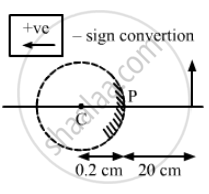
Using mirror formula,
\[\frac{1}{v} + \frac{1}{u} = \frac{2}{R}\]
Putting the values according to sign conventions, we get,

\[\frac{1}{( - 20)} + \frac{1}{v} = \frac{2}{0 . 2}\] 

\[ \Rightarrow   \frac{1}{v} = \frac{1}{20} + 10\] 

\[ \Rightarrow   v = 0 . 1  cm  or  1 . 0  \text{ mm  inside  the  ball  bearing . }\] 

\[Magnification = m\] 

\[ = \frac{A'B'}{AB} =  - \frac{v}{u} = m\] 

\[ = \frac{A'B'}{200} = \frac{1}{200}\] 

\[\Rightarrow A'B'=\frac{AB}{200}=+\frac{1 . 6}{200} =  + 0 . 08  \text{ cm }  (+0008\text{ cm })\]

Hence, the distance of the image is 1 cm.
Height of the image is 0.008 cm.

shaalaa.com
  Is there an error in this question or solution?
Chapter 18: Geometrical Optics - Exercise [Page 412]

APPEARS IN

HC Verma Concepts of Physics Vol. 1 [English] Class 11 and 12
Chapter 18 Geometrical Optics
Exercise | Q 5 | Page 412

RELATED QUESTIONS

Fill in the blank:

Very fine particles mainly scatter ………… colored light.


Draw the intensity distribution for the diffraction bands produced due to single slit ?


Why does the Sun look reddish at sunset or sunrise ?


What is linearly polarized light? 


Describe briefly using a diagram how sunlight is polarised ?


A thin lens is made with a material having refractive index
\[\mu = 1 \cdot 5\]. Both the side are convex. It is dipped in water \[\mu = 1 \cdot 33\]. It will behave like


A concave mirror has a focal length of 20 cm. Find the position or positions of an object for which the image-size is double of the object-size.


A 1 cm object is placed perpendicular to the principal axis of a convex mirror of focal length 7.5 cm. Find its distance from the mirror if the image formed is 0.6 cm in size.


A point source S is placed midway between two converging mirrors having equal focal length f as shown in figure. Find the values of d for which only one image is formed.


A cylindrical vessel, whose diameter and height both are equal to 30 cm, is placed on a horizontal surface and a small particle P is placed in it at a distance of 5.0 cm from the centre. An eye is placed at a position such that the edge of the bottom is just visible (see figure). The particle P is in the plane of drawing. Up to what minimum height should water be poured in the vessel to make the particle P visible?


Light falls from glass (μ = 1.5) to air. Find the angle of incidence for which the angle of deviation is 90°.


A biconvex thick lens is constructed with glass (μ = 1.50). Each of the surfaces has a radius of 10 cm and the thickness at the middle is 5 cm. Locate the image of an object placed far away from the lens.


One end of a cylindrical glass rod (μ = 1.5) of radius 1.0 cm is rounded in the shape of a hemisphere. The rod is immersed in water (μ = 4/3) and an object is placed in the water along the axis of the rod at a distance of 8.0 cm from the rounded edge. Locate the image of the object.


A paperweight in the form of a hemisphere of radius 3.0 cm is used to hold down a printed page. An observer looks at the page vertically through the paperweight. At what height above the page will the printed letters near the centre appear to the observer?


Fill in the blank and rewrite the completed statement:

Very fine particles mainly scatter ______ light.


Answer the following question in detail.

Explain the formation of a primary rainbow. For which angular range with the horizontal is it visible?


Answer the following question in detail.

Explain the formation of a secondary rainbow. For which angular range with the horizontal is it visible?


Answer the following question in detail.

Is it possible to see primary and secondary rainbow simultaneously? Under what conditions?


A short pulse of white light is incident from air to a glass slab at normal incidence. After travelling through the slab, the first colour to emerge is ______.


Share
Notifications

Englishहिंदीमराठी


      Forgot password?
Use app×