English
Karnataka Board PUCPUC Science Class 11

A Cylindrical Vessel, Whose Diameter and Height Both Are Equal to 30 Cm, is Placed on a Horizontal Surface and a Small Particle P is Placed in It at a Distance of 5.0 - Physics

Advertisements
Advertisements

Question

A cylindrical vessel, whose diameter and height both are equal to 30 cm, is placed on a horizontal surface and a small particle P is placed in it at a distance of 5.0 cm from the centre. An eye is placed at a position such that the edge of the bottom is just visible (see figure). The particle P is in the plane of drawing. Up to what minimum height should water be poured in the vessel to make the particle P visible?
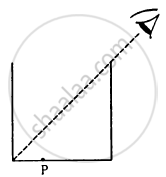
Sum
Advertisements

Solution

Given,
Diameter and height (h) of the cylindrical vessel = 30 cm
Therefore, its radius (r) = 15 cm
We know the refractive index of water (μw) = 1.33 
\[= \frac{4}{3}\] 
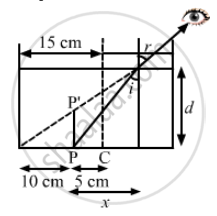
Using Snell's law,
\[\frac{\sin i}{\sin r} = \frac{1}{\mu_w}\]
\[\frac{\sin i}{\sin r} = \frac{3}{4}\]
\[As r = 45^\circ \]
\[ \Rightarrow \sin i = \frac{3}{4\sqrt{2}}\]
Point P will be visible when the refracted ray makes an angle of 45˚ at the point of refraction.
Let be the distance of point P from X.

\[\tan  45^\circ= \frac{x + 10}{d}\] 

\[ \Rightarrow d = x + 10           .  .  . (i)\] 

\[and  \] 

\[\tan  i = \frac{x}{d}\] 

\[ \Rightarrow \frac{3}{\sqrt{23}} = \frac{d - 10}{d}  \left( \because \sin  i = \frac{3}{4\sqrt{2}} \Rightarrow \tan  i = \frac{3}{\sqrt{23}} \right)\] 

\[ \Rightarrow \frac{3}{\sqrt{23}} - 1 = \frac{- 10}{d}\] 

\[ \Rightarrow d = \frac{\sqrt{23} \times 10}{\sqrt{23} - 3}\] 

\[d = 26 . 7  cm\]
Hence, the required minimum height of water = 26.7 cm

shaalaa.com
  Is there an error in this question or solution?
Chapter 18: Geometrical Optics - Exercise [Page 414]

APPEARS IN

HC Verma Concepts of Physics Vol. 1 [English] Class 11 and 12
Chapter 18 Geometrical Optics
Exercise | Q 24 | Page 414

RELATED QUESTIONS

Show with the help of a diagram, how unpolarised light from Sun gets linearly polarised by scattering.


Draw the intensity distribution for the fringes produced in interference ?


Draw the intensity distribution for the diffraction bands produced due to single slit ?


 Write two points of difference between the phenomena of interference and diffraction.


Suppose you are inside the water in a swimming pool near an edge. A friends is standing on the edge. Do you find your friend taller or shorter than his usual height?


A parallel beam of light is incident on a converging lens parallel to its principal axis. As one moves away from the lens on the other side on its principal axis, the intensity of light


A convex lens is made of a material having refractive index
\[1 \cdot 2\] Both the surfaces of the lens are convex. If it is dipped into water (μ = 1.33), it will behave like 


A point object O is placed on the principal axis of a convex lens of focal length f = 20 cm at a distance of 40 cm to the left of it. The diameter of the lens is 10 cm. An eye is placed 60 cm to right of the lens and a distance h below the principal axis. The maximum value of h to see the image is


A candle flame 1.6 cm high is imaged in a ball bearing of diameter 0.4 cm. If the ball bearing is 20 cm away from the flame, find the location and the height of the image.


Locate the image of the point P as seen by the eye in the figure.


k transparent slabs are arranged one over another. The refractive indices of the slabs are μ1, μ2, μ3, ... μk and the thicknesses are t1 t2t3, ... tk. An object is seen through this combination with nearly perpendicular light. Find the equivalent refractive index of the system which will allow the image to be formed at the same place.


Light is incident from glass (μ = 1.50) to water (μ = 1.33). Find the range of the angle of deviation for which there are two angles of incidence.


Explain: ‘How is a rainbow formed’?


Answer the following question in detail.

State the conditions under which a rainbow can be seen.


Explain the formation of primary and secondary rainbow.


A parallel beam of light of wavelength 5890 Å falls normally on a slit of width 0.2 mm. Find the distance between the first minima on the two sides of the central maximum of the diffraction pattern observed on a screen placed in the focal plane of a convex lens of focal length 50 cm. The lens is placed quite close to the slit.


Case study: Mirage in deserts 

To a distant observer, the light appears to be coming from somewhere below the ground. The observer naturally assumes that light is being reflected from the ground, say, by a pool of water near the tall object.

Such inverted images of distant tall objects cause an optical illusion to the observer. This phenomenon is called mirage. This type of mirage is especially common in hot deserts.

Based on the above facts, answer the following question:

Which of the following phenomena is prominently involved in the formation of mirage in deserts?


Case study: Mirage in deserts

To a distant observer, the light appears to be coming from somewhere below the ground. The observer naturally assumes that light is being reflected from the ground, say, by a pool of water near the tall object.

Such inverted images of distant tall objects cause an optical illusion to the observer. This phenomenon is called mirage. This type of mirage is especially common in hot deserts.

Based on the above facts, answer the following question :

 A diver at a depth 12 m inside water `(a_(µω) = 4/3)` sees the sky in a cone of semi-vertical angle


Case study: Mirage in deserts

To a distant observer, the light appears to be coming from somewhere below the ground. The observer naturally assumes that light is being reflected from the ground, say, by a pool of water near the tall object.

Such inverted images of distant tall objects cause an optical illusion to the observer. This phenomenon is called mirage. This type of mirage is especially common in hot deserts.

Based on the above facts, answer the following question:

The following figure shows a cross-section of a ‘light pipe’ made of a glass fiber of refractive index 1.68. The outer covering of the pipe is made of a material of refractive index 1.44. What is the range of the angles of the incident rays with the axis of the pipe for the following phenomena to occur.


Share
Notifications

Englishहिंदीमराठी


      Forgot password?
Use app×