Advertisements
Advertisements
प्रश्न
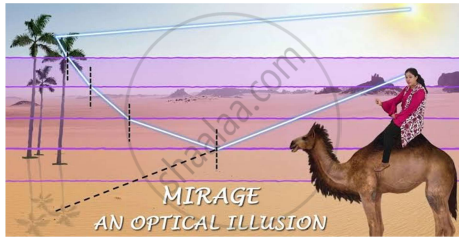
| Case study: Mirage in deserts |
 |
|
To a distant observer, the light appears to be coming from somewhere below the ground. The observer naturally assumes that light is being reflected from the ground, say, by a pool of water near the tall object. Such inverted images of distant tall objects cause an optical illusion to the observer. This phenomenon is called mirage. This type of mirage is especially common in hot deserts. Based on the above facts, answer the following question: |
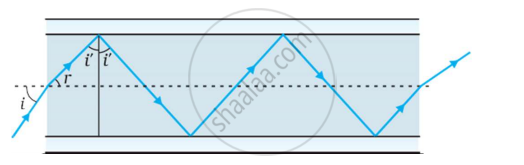
The following figure shows a cross-section of a ‘light pipe’ made of a glass fiber of refractive index 1.68. The outer covering of the pipe is made of a material of refractive index 1.44. What is the range of the angles of the incident rays with the axis of the pipe for the following phenomena to occur.
विकल्प
0 < i < 90°
0 < i < 60°
0 < i < 45°
0 < i < 30°
Advertisements
उत्तर
0 < i < 60°
Explanation -
`1_(mu_2) = 1/(Sin "C'")`
Sin C' = `1.44/1.68` = 0.8571
C' ⇒ 59°
Total internal reflection will occur if the angle `"i'" > "i"_"c"^"'"`,
i.e., if i' > 59° or when r < rmax’ where rmax = 90° – 59° = 31°.
Using Snell’s law,
`("Sin" "i"_"max")/("Sin" "r"_"max")` = 1.68
or Sin imax = 1.68 × Sin rmax
= 1.68 × sin 31°
= 1.68 × 0.5150
= 0.8662
∴ imax = 60°
Thus all incident rays which make angles in the range 0 < i < 60° with the axis of the pipe will suffer total internal reflections in the pipe.
