हिंदी
कर्नाटक बोर्ड पी.यू.सी.पीयूसी विज्ञान कक्षा ११

A Biconvex Thick Lens is Constructed with Glass (μ = 1.50). Each of the Surfaces Has a Radius of 10 Cm and the Thickness at the Middle is 5 Cm. - Physics

Advertisements
Advertisements

प्रश्न

A biconvex thick lens is constructed with glass (μ = 1.50). Each of the surfaces has a radius of 10 cm and the thickness at the middle is 5 cm. Locate the image of an object placed far away from the lens.

योग
Advertisements

उत्तर

Given,
Biconvex lens with each surface has a radius (R1 R2 = R) = 10 cm,
and thickness of the lens (t) = 5 cm
Refractive index of the lens (μ) = 1.50
Object is at infinity (∴ u = ∞ )
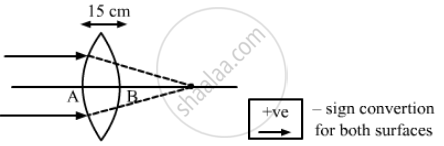
First refraction takes place at A.
We know that,

\[\frac{\mu_g}{v} - \frac{\mu_a}{u} = \frac{\mu_g - \mu_a}{R}\] 

\[ \Rightarrow \frac{1 . 5}{v} - \left( - \frac{1}{\infty} \right) = \frac{1 . 5 - 1}{10}\] 

\[ \Rightarrow \frac{1 . 5}{v} = \frac{0 . 5}{10}\] 

\[ \Rightarrow v =   30  \text{ cm }\]
Now, the second refraction is at B.
For this, a virtual object is the image of the previous refraction.
Thus, u = (30 − 5) = 25 cm

\[\frac{\mu_a}{v} - \frac{\mu_g}{u} = \frac{\mu_a - \mu_g}{R}\] 

\[ \Rightarrow \frac{1}{v} - \frac{1 . 5}{25} = \frac{1 - 1 . 5}{10}\] 

\[ \Rightarrow \frac{1}{v} - \frac{1 . 5}{25} = \frac{- 0 . 5}{10}\] 
\[ \Rightarrow v =   9 . 1  cm\]
Hence, the image is formed 9.1 cm far from the second refraction or second surface of the lens.

shaalaa.com
  क्या इस प्रश्न या उत्तर में कोई त्रुटि है?
अध्याय 18: Geometrical Optics - Exercise [पृष्ठ ४१५]

APPEARS IN

एचसी वर्मा Concepts of Physics Vol. 1 [English] Class 11 and 12
अध्याय 18 Geometrical Optics
Exercise | Q 41 | पृष्ठ ४१५

संबंधित प्रश्न

Fill in the blank:

Very fine particles mainly scatter ………… colored light.


Why does unpolarised light from a source show a variation in intensity when viewed through a polaroid which is rotated?


Show with the help of a diagram, how unpolarised light from Sun gets linearly polarised by scattering.


Describe briefly using a diagram how sunlight is polarised ?


Suppose you are inside the water in a swimming pool near an edge. A friends is standing on the edge. Do you find your friend taller or shorter than his usual height?


A thin lens is made with a material having refractive index
\[\mu = 1 \cdot 5\]. Both the side are convex. It is dipped in water \[\mu = 1 \cdot 33\]. It will behave like


A point object O is placed on the principal axis of a convex lens of focal length f = 20 cm at a distance of 40 cm to the left of it. The diameter of the lens is 10 cm. An eye is placed 60 cm to right of the lens and a distance h below the principal axis. The maximum value of h to see the image is


A concave mirror forms an image of 20 cm high object on a screen placed 5.0 m away from the mirror. The height of the image is 50 cm. Find the focal length of the mirror and the distance between the mirror and the object.


k transparent slabs are arranged one over another. The refractive indices of the slabs are μ1, μ2, μ3, ... μk and the thicknesses are t1 t2t3, ... tk. An object is seen through this combination with nearly perpendicular light. Find the equivalent refractive index of the system which will allow the image to be formed at the same place.


A cylindrical vessel, whose diameter and height both are equal to 30 cm, is placed on a horizontal surface and a small particle P is placed in it at a distance of 5.0 cm from the centre. An eye is placed at a position such that the edge of the bottom is just visible (see figure). The particle P is in the plane of drawing. Up to what minimum height should water be poured in the vessel to make the particle P visible?


A point source is placed at a depth h below the surface of water (refractive index = μ). (a) Show that light escapes through a circular area on the water surface with its centre directly above the point source. (b) Find the angle subtended by a radius of the area on the source.


A paperweight in the form of a hemisphere of radius 3.0 cm is used to hold down a printed page. An observer looks at the page vertically through the paperweight. At what height above the page will the printed letters near the centre appear to the observer?


The diameter of the sun is 1.4 × 10⁹ m and its distance from the earth is 1.5 × 10¹¹ m. Find the radius of the image of the sun formed by a lens of focal length 20 cm.


Answer the following question in detail.

Explain the formation of a secondary rainbow. For which angular range with the horizontal is it visible?


Case study: Mirage in deserts 

To a distant observer, the light appears to be coming from somewhere below the ground. The observer naturally assumes that light is being reflected from the ground, say, by a pool of water near the tall object.

Such inverted images of distant tall objects cause an optical illusion to the observer. This phenomenon is called mirage. This type of mirage is especially common in hot deserts.

Based on the above facts, answer the following question:

Which of the following phenomena is prominently involved in the formation of mirage in deserts?


Case study: Mirage in deserts

To a distant observer, the light appears to be coming from somewhere below the ground. The observer naturally assumes that light is being reflected from the ground, say, by a pool of water near the tall object.

Such inverted images of distant tall objects cause an optical illusion to the observer. This phenomenon is called mirage. This type of mirage is especially common in hot deserts.

Based on the above facts, answer the following question :

 A diver at a depth 12 m inside water `(a_(µω) = 4/3)` sees the sky in a cone of semi-vertical angle


The sky would appear red instead of blue if


A short pulse of white light is incident from air to a glass slab at normal incidence. After travelling through the slab, the first colour to emerge is ______.


Share
Notifications

Englishहिंदीमराठी


      Forgot password?
Use app×