Advertisements
Advertisements
प्रश्न
| Case study: Mirage in deserts |
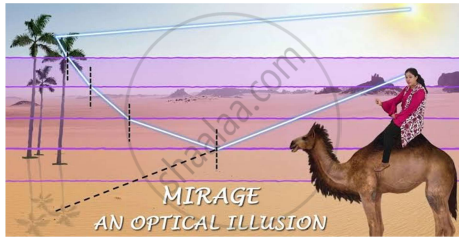
![]() |
|
To a distant observer, the light appears to be coming from somewhere below the ground. The observer naturally assumes that light is being reflected from the ground, say, by a pool of water near the tall object. Such inverted images of distant tall objects cause an optical illusion to the observer. This phenomenon is called mirage. This type of mirage is especially common in hot deserts. Based on the above facts, answer the following question: |
Which of the following phenomena is prominently involved in the formation of mirage in deserts?
विकल्प
Refraction, Total internal Reflection
Dispersion and Refraction
Dispersion and scattering of light
Total internal Reflection and diffraction
Advertisements
उत्तर
Refraction, Total internal reflection
APPEARS IN
संबंधित प्रश्न
Write two points of difference between the phenomena of interference and diffraction.
What is linearly polarized light?
A concave mirror forms an image of 20 cm high object on a screen placed 5.0 m away from the mirror. The height of the image is 50 cm. Find the focal length of the mirror and the distance between the mirror and the object.
One end of a cylindrical glass rod (μ = 1.5) of radius 1.0 cm is rounded in the shape of a hemisphere. The rod is immersed in water (μ = 4/3) and an object is placed in the water along the axis of the rod at a distance of 8.0 cm from the rounded edge. Locate the image of the object.
The diameter of the sun is 1.4 × 10⁹ m and its distance from the earth is 1.5 × 10¹¹ m. Find the radius of the image of the sun formed by a lens of focal length 20 cm.
Explain: ‘How is a rainbow formed’?
Answer the following question in detail.
State the conditions under which a rainbow can be seen.
A plano-convex lens is made of material having refractive index 1.5. The radius of curvature of curved surface is 40 cm. The focal length of the lens is ____________ cm.
A short pulse of white light is incident from air to a glass slab at normal incidence. After travelling through the slab, the first colour to emerge is ______.
A passenger in an aeroplane shall ______.

