हिंदी
कर्नाटक बोर्ड पी.यू.सी.पीयूसी विज्ञान कक्षा ११

A Concave Mirror Has a Focal Length of 20 Cm. Find the Position Or Positions of an Object for Which the Image-size is Double of the Object-size. - Physics

Advertisements
Advertisements

प्रश्न

A concave mirror has a focal length of 20 cm. Find the position or positions of an object for which the image-size is double of the object-size.

योग
Advertisements

उत्तर

Using sign conventions, given,
Focal length of the concave mirror:
f = −20 cm
As per the question,
Magnification (m) is:
\[m =  - \frac{v}{u} = 2\] 
⇒ v = −2u
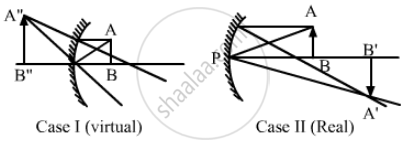
 Case I (Virtual image):

Using mirror formula,

\[\frac{1}{v} + \frac{1}{u} = \frac{1}{f}\] 

\[ \Rightarrow    - \frac{1}{2u} - \frac{1}{u} = \frac{1}{f}\] 

\[ \Rightarrow   \frac{3}{2u} = \frac{1}{f}\] 

\[ \Rightarrow   u = \frac{3f}{2} = 30  \text{ cm }\]
Hence, the required positions of objects are 10 cm or 30 cm from the concave mirror. 

shaalaa.com
  क्या इस प्रश्न या उत्तर में कोई त्रुटि है?
अध्याय 18: Geometrical Optics - Exercise [पृष्ठ ४१२]

APPEARS IN

एचसी वर्मा Concepts of Physics Vol. 1 [English] Class 11 and 12
अध्याय 18 Geometrical Optics
Exercise | Q 3 | पृष्ठ ४१२

संबंधित प्रश्न

Fill in the blank:

Very fine particles mainly scatter ………… colored light.


Draw the intensity distribution for the fringes produced in interference ?


Suppose you are inside the water in a swimming pool near an edge. A friends is standing on the edge. Do you find your friend taller or shorter than his usual height?


The image formed by a concave mirror


A parallel beam of light is incident on a converging lens parallel to its principal axis. As one moves away from the lens on the other side on its principal axis, the intensity of light


A thin lens is made with a material having refractive index
\[\mu = 1 \cdot 5\]. Both the side are convex. It is dipped in water \[\mu = 1 \cdot 33\]. It will behave like


A concave mirror forms an image of 20 cm high object on a screen placed 5.0 m away from the mirror. The height of the image is 50 cm. Find the focal length of the mirror and the distance between the mirror and the object.


A 1 cm object is placed perpendicular to the principal axis of a convex mirror of focal length 7.5 cm. Find its distance from the mirror if the image formed is 0.6 cm in size.


A candle flame 1.6 cm high is imaged in a ball bearing of diameter 0.4 cm. If the ball bearing is 20 cm away from the flame, find the location and the height of the image.


A 3 cm tall object is placed at a distance of 7.5 cm from a convex mirror of focal length 6 cm. Find the location, size and nature of the image.


A converging mirror M1, a point source S and a diverging mirror M2 are arranged as shown in figure. The source is placed at a distance of 30 cm from M1. The focal length of each of the mirrors is 20 cm. Consider only the images formed by a maximum of two reflections. It is found that one image is formed on the source itself. (a) Find the distance between the two mirrors. (b) Find the location of the image formed by the single reflection from M2.


A cylindrical vessel, whose diameter and height both are equal to 30 cm, is placed on a horizontal surface and a small particle P is placed in it at a distance of 5.0 cm from the centre. An eye is placed at a position such that the edge of the bottom is just visible (see figure). The particle P is in the plane of drawing. Up to what minimum height should water be poured in the vessel to make the particle P visible?


A point source is placed at a depth h below the surface of water (refractive index = μ). (a) Show that light escapes through a circular area on the water surface with its centre directly above the point source. (b) Find the angle subtended by a radius of the area on the source.


One end of a cylindrical glass rod (μ = 1.5) of radius 1.0 cm is rounded in the shape of a hemisphere. The rod is immersed in water (μ = 4/3) and an object is placed in the water along the axis of the rod at a distance of 8.0 cm from the rounded edge. Locate the image of the object.


Answer the following question in detail.

Is it possible to see primary and secondary rainbow simultaneously? Under what conditions?


Explain the formation of primary and secondary rainbow.


A parallel beam of light of wavelength 5890 Å falls normally on a slit of width 0.2 mm. Find the distance between the first minima on the two sides of the central maximum of the diffraction pattern observed on a screen placed in the focal plane of a convex lens of focal length 50 cm. The lens is placed quite close to the slit.


A short pulse of white light is incident from air to a glass slab at normal incidence. After travelling through the slab, the first colour to emerge is ______.


Share
Notifications

Englishहिंदीमराठी


      Forgot password?
Use app×