Advertisements
Advertisements
प्रश्न
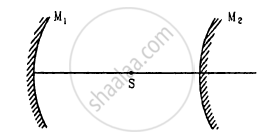
A converging mirror M1, a point source S and a diverging mirror M2 are arranged as shown in figure. The source is placed at a distance of 30 cm from M1. The focal length of each of the mirrors is 20 cm. Consider only the images formed by a maximum of two reflections. It is found that one image is formed on the source itself. (a) Find the distance between the two mirrors. (b) Find the location of the image formed by the single reflection from M2.
Advertisements
उत्तर
Given,
Converging mirror M1 with focal length (f1) = 20 cm
Converging mirror M2 with focal length (f2) = 20 cm
f1 = f2 = 20 cm = f
Point source is at a distance of 30 cm from M1.
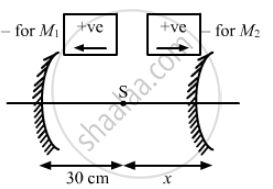
As the 1st reflection is through the mirror M1,
u = −30 cm
f = −20 cm
Using mirror equation:
\[\Rightarrow \frac{1}{v} + \frac{1}{u} = \frac{1}{f}\]
\[\Rightarrow \frac{1}{v} + \frac{1}{- 30} = - \frac{1}{20}\]
\[\Rightarrow \frac{1}{v} = - \frac{1}{20} + \frac{1}{30}\]
\[ \Rightarrow \frac{1}{v} = - \frac{1}{60}\]
\[ \Rightarrow v = - 60 \text{ cm }\]
and for the 2nd reflection at mirror M2,
u = 60 − (30 + x) = 30 − x
v = − x, f = 20 cm
Again using the mirror equation:
\[\Rightarrow \frac{1}{30 - x} - \frac{1}{x} = \frac{1}{20}\]
\[\Rightarrow \frac{x - 30 + x}{x(30 - x)} = \frac{1}{20}\]
⇒ 40x − 600 = 30x − x2
⇒ x2 + 10x − 600 = 0
\[\Rightarrow x = \frac{10 + 50}{2} = \frac{40}{2}\]
= 20 cm or − 30 cm
∴ Total distance between the two lines is 20 + 30 = 50 cm
(b) Location of the image formed by the single reflection from M2 = 60 \[-\] 50 = 10
Thus, the image formed by the single reflection from M2 is at a distance of 10 cm from mirror M2.
APPEARS IN
संबंधित प्रश्न
Fill in the blank:
Very fine particles mainly scatter ………… colored light.
Name the phenomenon responsible for it.
Draw the intensity distribution for the fringes produced in interference ?
Draw the intensity distribution for the diffraction bands produced due to single slit ?
Write two points of difference between the phenomena of interference and diffraction.
In the meterbridge experimental set up, shown in the figure, the null point ‘D’ is obtained at a distance of 40 cm from end A of the meterbridge wire. If a resistance of 10Ω is connected in series with R1, null point is obtained at AD = 60 cm. Calculate the values of R1 and R2.
A point object O is placed on the principal axis of a convex lens of focal length f = 20 cm at a distance of 40 cm to the left of it. The diameter of the lens is 10 cm. An eye is placed 60 cm to right of the lens and a distance h below the principal axis. The maximum value of h to see the image is
A 1 cm object is placed perpendicular to the principal axis of a convex mirror of focal length 7.5 cm. Find its distance from the mirror if the image formed is 0.6 cm in size.
A 3 cm tall object is placed at a distance of 7.5 cm from a convex mirror of focal length 6 cm. Find the location, size and nature of the image.
Light is incident from glass (μ = 1.50) to water (μ = 1.33). Find the range of the angle of deviation for which there are two angles of incidence.
A container contains water up to a height of 20 cm and there is a point source at the centre of the bottom of the container. A rubber ring of radius r floats centrally on the water. The ceiling of the room is 2.0 m above the water surface. (a) Find the radius of the shadow of the ring formed on the ceiling if r = 15 cm. (b) Find the maximum value of r for which the shadow of the ring is formed on the ceiling. Refractive index of water = 4/3.
Pick the wrong answer in the context with rainbow.
A plano-convex lens is made of material having refractive index 1.5. The radius of curvature of curved surface is 40 cm. The focal length of the lens is ____________ cm.
State any one difference between a primary rainbow and a secondary rainbow.
| Case study: Mirage in deserts |
![]() |
|
To a distant observer, the light appears to be coming from somewhere below the ground. The observer naturally assumes that light is being reflected from the ground, say, by a pool of water near the tall object. Such inverted images of distant tall objects cause an optical illusion to the observer. This phenomenon is called mirage. This type of mirage is especially common in hot deserts. Based on the above facts, answer the following question: |
The following figure shows a cross-section of a ‘light pipe’ made of a glass fiber of refractive index 1.68. The outer covering of the pipe is made of a material of refractive index 1.44. What is the range of the angles of the incident rays with the axis of the pipe for the following phenomena to occur.

A short pulse of white light is incident from air to a glass slab at normal incidence. After travelling through the slab, the first colour to emerge is ______.
A passenger in an aeroplane shall ______.

