Advertisements
Advertisements
प्रश्न
A concave mirror forms an image of 20 cm high object on a screen placed 5.0 m away from the mirror. The height of the image is 50 cm. Find the focal length of the mirror and the distance between the mirror and the object.
Advertisements
उत्तर
Given,
Height of the object, h1 = 20 cm,
Distance of image from screen v = −5.0 m = −500 cm,
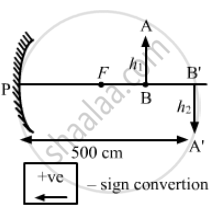
\[- \frac{v}{u} = \frac{h_2}{h_1}\]
\[or \frac{- ( - 500)}{u} = \frac{50}{20}\]
Where 'u' is the distance of object from screen.
(As the image is inverted)
Using mirror formula,
\[\frac{1}{v} + \frac{1}{u} = \frac{1}{f}\]
\[or \frac{1}{- 5} + \frac{1}{- 2} = \frac{1}{f}\]
\[or - \frac{1}{f} = \frac{7}{10}\]
\[or f = - \frac{10}{7} = - 1 . 44 \text{ m }\]
Hence, the required focal length of the concave mirror is 1.44 m.
APPEARS IN
संबंधित प्रश्न
Give a scientific reason:
Danger signals are red in colour.
Why can’t we see clearly through fog?
Why does unpolarised light from a source show a variation in intensity when viewed through a polaroid which is rotated?
In the meterbridge experimental set up, shown in the figure, the null point ‘D’ is obtained at a distance of 40 cm from end A of the meterbridge wire. If a resistance of 10Ω is connected in series with R1, null point is obtained at AD = 60 cm. Calculate the values of R1 and R2.
Describe briefly using a diagram how sunlight is polarised ?
A concave mirror having a radius of curvature 40 cm is placed in front of an illuminated point source at a distance of 30 cm from it. Find the location of the image.
A 3 cm tall object is placed at a distance of 7.5 cm from a convex mirror of focal length 6 cm. Find the location, size and nature of the image.
k transparent slabs are arranged one over another. The refractive indices of the slabs are μ1, μ2, μ3, ... μk and the thicknesses are t1 t2, t3, ... tk. An object is seen through this combination with nearly perpendicular light. Find the equivalent refractive index of the system which will allow the image to be formed at the same place.
An optical fibre (μ = 1.72) is surrounded by a glass coating (μ = 1.50). Find the critical angle for total internal reflection at the fibre-glass interface.
A point source is placed at a depth h below the surface of water (refractive index = μ). (a) Show that light escapes through a circular area on the water surface with its centre directly above the point source. (b) Find the angle subtended by a radius of the area on the source.
One end of a cylindrical glass rod (μ = 1.5) of radius 1.0 cm is rounded in the shape of a hemisphere. The rod is immersed in water (μ = 4/3) and an object is placed in the water along the axis of the rod at a distance of 8.0 cm from the rounded edge. Locate the image of the object.
A paperweight in the form of a hemisphere of radius 3.0 cm is used to hold down a printed page. An observer looks at the page vertically through the paperweight. At what height above the page will the printed letters near the centre appear to the observer?
Answer the following question in detail.
State the conditions under which a rainbow can be seen.
Answer the following question in detail.
Explain the formation of a secondary rainbow. For which angular range with the horizontal is it visible?
Rainbow is the phenomenon due to ______.
A plano-convex lens is made of material having refractive index 1.5. The radius of curvature of curved surface is 40 cm. The focal length of the lens is ____________ cm.
A parallel beam of light of wavelength 5890 Å falls normally on a slit of width 0.2 mm. Find the distance between the first minima on the two sides of the central maximum of the diffraction pattern observed on a screen placed in the focal plane of a convex lens of focal length 50 cm. The lens is placed quite close to the slit.
| Case study: Mirage in deserts |
![]() |
|
To a distant observer, the light appears to be coming from somewhere below the ground. The observer naturally assumes that light is being reflected from the ground, say, by a pool of water near the tall object. Such inverted images of distant tall objects cause an optical illusion to the observer. This phenomenon is called mirage. This type of mirage is especially common in hot deserts. Based on the above facts, answer the following question : |
A diver at a depth 12 m inside water `(a_(µω) = 4/3)` sees the sky in a cone of semi-vertical angle
| Case study: Mirage in deserts |
![]() |
|
To a distant observer, the light appears to be coming from somewhere below the ground. The observer naturally assumes that light is being reflected from the ground, say, by a pool of water near the tall object. Such inverted images of distant tall objects cause an optical illusion to the observer. This phenomenon is called mirage. This type of mirage is especially common in hot deserts. Based on the above facts, answer the following question: |
The following figure shows a cross-section of a ‘light pipe’ made of a glass fiber of refractive index 1.68. The outer covering of the pipe is made of a material of refractive index 1.44. What is the range of the angles of the incident rays with the axis of the pipe for the following phenomena to occur.

The sky would appear red instead of blue if


