Advertisements
Advertisements
Question
A concave mirror has a focal length of 20 cm. Find the position or positions of an object for which the image-size is double of the object-size.
Advertisements
Solution
Using sign conventions, given,
Focal length of the concave mirror:
f = −20 cm
As per the question,
Magnification (m) is:
\[m = - \frac{v}{u} = 2\]
⇒ v = −2u
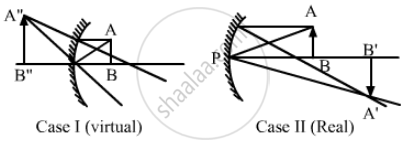
Case I (Virtual image):
Using mirror formula,
\[\frac{1}{v} + \frac{1}{u} = \frac{1}{f}\]
\[ \Rightarrow - \frac{1}{2u} - \frac{1}{u} = \frac{1}{f}\]
\[ \Rightarrow \frac{3}{2u} = \frac{1}{f}\]
\[ \Rightarrow u = \frac{3f}{2} = 30 \text{ cm }\]
Hence, the required positions of objects are 10 cm or 30 cm from the concave mirror.
APPEARS IN
RELATED QUESTIONS
Fill in the blank:
Very fine particles mainly scatter ………… colored light.
Name the phenomenon responsible for it.
Draw the intensity distribution for the fringes produced in interference ?
Suppose you are inside the water in a swimming pool near an edge. A friends is standing on the edge. Do you find your friend taller or shorter than his usual height?
The image formed by a concave mirror
A thin lens is made with a material having refractive index
\[\mu = 1 \cdot 5\]. Both the side are convex. It is dipped in water \[\mu = 1 \cdot 33\]. It will behave like
A concave mirror having a radius of curvature 40 cm is placed in front of an illuminated point source at a distance of 30 cm from it. Find the location of the image.
A cylindrical vessel, whose diameter and height both are equal to 30 cm, is placed on a horizontal surface and a small particle P is placed in it at a distance of 5.0 cm from the centre. An eye is placed at a position such that the edge of the bottom is just visible (see figure). The particle P is in the plane of drawing. Up to what minimum height should water be poured in the vessel to make the particle P visible?

Light is incident from glass (μ = 1.50) to water (μ = 1.33). Find the range of the angle of deviation for which there are two angles of incidence.
A point source is placed at a depth h below the surface of water (refractive index = μ). (a) Show that light escapes through a circular area on the water surface with its centre directly above the point source. (b) Find the angle subtended by a radius of the area on the source.
A biconvex thick lens is constructed with glass (μ = 1.50). Each of the surfaces has a radius of 10 cm and the thickness at the middle is 5 cm. Locate the image of an object placed far away from the lens.
Answer the following question in detail.
Explain the formation of a secondary rainbow. For which angular range with the horizontal is it visible?
Answer the following question in detail.
Is it possible to see primary and secondary rainbow simultaneously? Under what conditions?
Pick the wrong answer in the context with rainbow.
Explain the formation of primary and secondary rainbow.
| Case study: Mirage in deserts |
![]() |
|
To a distant observer, the light appears to be coming from somewhere below the ground. The observer naturally assumes that light is being reflected from the ground, say, by a pool of water near the tall object. Such inverted images of distant tall objects cause an optical illusion to the observer. This phenomenon is called mirage. This type of mirage is especially common in hot deserts. Based on the above facts, answer the following question : |
A diver at a depth 12 m inside water `(a_(µω) = 4/3)` sees the sky in a cone of semi-vertical angle
The sky would appear red instead of blue if

