English
Karnataka Board PUCPUC Science Class 11

An Optical Fibre (μ = 1.72) is Surrounded by a Glass Coating (μ = 1.50). Find the Critical Angle for Total Internal Reflection at the Fibre-glass Interface. - Physics

Advertisements
Advertisements

Question

An optical fibre (μ = 1.72) is surrounded by a glass coating (μ = 1.50). Find the critical angle for total internal reflection at the fibre-glass interface.

Sum
Advertisements

Solution

Given,
Refractive index of the optical fibre is represented by μo = 1.72
Refractive index of glass coating is represented by μg= 1.50
Let the critical angle for glass be θc

Using the Snell's law,
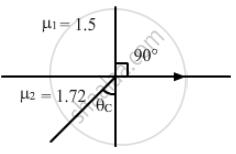
\[\frac{\sin  i}{\sin  r} = \frac{\sin  \theta_c}{\sin  90^\circ } = \frac{\mu_g}{\mu_0}\] 

\[ \Rightarrow \frac{\sin  \theta_c}{\sin  90^\circ } = \frac{1 . 50}{1 . 72} = \frac{75}{86}\] 

\[ \Rightarrow    \theta_c  =  \sin^{- 1} \left( \frac{75}{86} \right)\]
Hence, the required critical angle is \[\sin^{- 1} \left( \frac{75}{86} \right)\] 

shaalaa.com
  Is there an error in this question or solution?
Chapter 18: Geometrical Optics - Exercise [Page 414]

APPEARS IN

HC Verma Concepts of Physics Vol. 1 [English] Class 11 and 12
Chapter 18 Geometrical Optics
Exercise | Q 26 | Page 414

RELATED QUESTIONS

Name the phenomenon responsible for it.


Why does unpolarised light from a source show a variation in intensity when viewed through a polaroid which is rotated?


Draw the intensity distribution for the fringes produced in interference ?


Why does the Sun look reddish at sunset or sunrise ?


Describe briefly using a diagram how sunlight is polarised ?


The image formed by a concave mirror


A parallel beam of light is incident on a converging lens parallel to its principal axis. As one moves away from the lens on the other side on its principal axis, the intensity of light


A thin lens is made with a material having refractive index
\[\mu = 1 \cdot 5\]. Both the side are convex. It is dipped in water \[\mu = 1 \cdot 33\]. It will behave like


A convex lens is made of a material having refractive index
\[1 \cdot 2\] Both the surfaces of the lens are convex. If it is dipped into water (μ = 1.33), it will behave like 


A concave mirror has a focal length of 20 cm. Find the position or positions of an object for which the image-size is double of the object-size.


A 3 cm tall object is placed at a distance of 7.5 cm from a convex mirror of focal length 6 cm. Find the location, size and nature of the image.


Light falls from glass (μ = 1.5) to air. Find the angle of incidence for which the angle of deviation is 90°.


A biconvex thick lens is constructed with glass (μ = 1.50). Each of the surfaces has a radius of 10 cm and the thickness at the middle is 5 cm. Locate the image of an object placed far away from the lens.


One end of a cylindrical glass rod (μ = 1.5) of radius 1.0 cm is rounded in the shape of a hemisphere. The rod is immersed in water (μ = 4/3) and an object is placed in the water along the axis of the rod at a distance of 8.0 cm from the rounded edge. Locate the image of the object.


A paperweight in the form of a hemisphere of radius 3.0 cm is used to hold down a printed page. An observer looks at the page vertically through the paperweight. At what height above the page will the printed letters near the centre appear to the observer?


Rainbow is the phenomenon due to ______.


State any one difference between a primary rainbow and a secondary rainbow.


A parallel beam of light of wavelength 5890 Å falls normally on a slit of width 0.2 mm. Find the distance between the first minima on the two sides of the central maximum of the diffraction pattern observed on a screen placed in the focal plane of a convex lens of focal length 50 cm. The lens is placed quite close to the slit.


A passenger in an aeroplane shall ______.


Share
Notifications

Englishहिंदीमराठी


      Forgot password?
Use app×