हिंदी
कर्नाटक बोर्ड पी.यू.सी.पीयूसी विज्ञान कक्षा ११

An Optical Fibre (μ = 1.72) is Surrounded by a Glass Coating (μ = 1.50). Find the Critical Angle for Total Internal Reflection at the Fibre-glass Interface. - Physics

Advertisements
Advertisements

प्रश्न

An optical fibre (μ = 1.72) is surrounded by a glass coating (μ = 1.50). Find the critical angle for total internal reflection at the fibre-glass interface.

योग
Advertisements

उत्तर

Given,
Refractive index of the optical fibre is represented by μo = 1.72
Refractive index of glass coating is represented by μg= 1.50
Let the critical angle for glass be θc

Using the Snell's law,
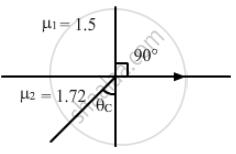
\[\frac{\sin  i}{\sin  r} = \frac{\sin  \theta_c}{\sin  90^\circ } = \frac{\mu_g}{\mu_0}\] 

\[ \Rightarrow \frac{\sin  \theta_c}{\sin  90^\circ } = \frac{1 . 50}{1 . 72} = \frac{75}{86}\] 

\[ \Rightarrow    \theta_c  =  \sin^{- 1} \left( \frac{75}{86} \right)\]
Hence, the required critical angle is \[\sin^{- 1} \left( \frac{75}{86} \right)\] 

shaalaa.com
  क्या इस प्रश्न या उत्तर में कोई त्रुटि है?
अध्याय 18: Geometrical Optics - Exercise [पृष्ठ ४१४]

APPEARS IN

एचसी वर्मा Concepts of Physics Vol. 1 [English] Class 11 and 12
अध्याय 18 Geometrical Optics
Exercise | Q 26 | पृष्ठ ४१४

संबंधित प्रश्न

Why can’t we see clearly through fog?


Name the phenomenon responsible for it.


Why does unpolarised light from a source show a variation in intensity when viewed through a polaroid which is rotated?


 Write two points of difference between the phenomena of interference and diffraction.


A parallel beam of light is incident on a converging lens parallel to its principal axis. As one moves away from the lens on the other side on its principal axis, the intensity of light


A point object O is placed on the principal axis of a convex lens of focal length f = 20 cm at a distance of 40 cm to the left of it. The diameter of the lens is 10 cm. An eye is placed 60 cm to right of the lens and a distance h below the principal axis. The maximum value of h to see the image is


A concave mirror has a focal length of 20 cm. Find the position or positions of an object for which the image-size is double of the object-size.


A 3 cm tall object is placed at a distance of 7.5 cm from a convex mirror of focal length 6 cm. Find the location, size and nature of the image.


A point source S is placed midway between two converging mirrors having equal focal length f as shown in figure. Find the values of d for which only one image is formed.


A converging mirror M1, a point source S and a diverging mirror M2 are arranged as shown in figure. The source is placed at a distance of 30 cm from M1. The focal length of each of the mirrors is 20 cm. Consider only the images formed by a maximum of two reflections. It is found that one image is formed on the source itself. (a) Find the distance between the two mirrors. (b) Find the location of the image formed by the single reflection from M2.


A point source is placed at a depth h below the surface of water (refractive index = μ). (a) Show that light escapes through a circular area on the water surface with its centre directly above the point source. (b) Find the angle subtended by a radius of the area on the source.


A paperweight in the form of a hemisphere of radius 3.0 cm is used to hold down a printed page. An observer looks at the page vertically through the paperweight. At what height above the page will the printed letters near the centre appear to the observer?


The diameter of the sun is 1.4 × 10⁹ m and its distance from the earth is 1.5 × 10¹¹ m. Find the radius of the image of the sun formed by a lens of focal length 20 cm.


Fill in the blank and rewrite the completed statement:

Very fine particles mainly scatter ______ light.


Explain: ‘How is a rainbow formed’?


Case study: Mirage in deserts

To a distant observer, the light appears to be coming from somewhere below the ground. The observer naturally assumes that light is being reflected from the ground, say, by a pool of water near the tall object.

Such inverted images of distant tall objects cause an optical illusion to the observer. This phenomenon is called mirage. This type of mirage is especially common in hot deserts.

Based on the above facts, answer the following question :

 A diver at a depth 12 m inside water `(a_(µω) = 4/3)` sees the sky in a cone of semi-vertical angle


Case study: Mirage in deserts

To a distant observer, the light appears to be coming from somewhere below the ground. The observer naturally assumes that light is being reflected from the ground, say, by a pool of water near the tall object.

Such inverted images of distant tall objects cause an optical illusion to the observer. This phenomenon is called mirage. This type of mirage is especially common in hot deserts.

Based on the above facts, answer the following question:

The following figure shows a cross-section of a ‘light pipe’ made of a glass fiber of refractive index 1.68. The outer covering of the pipe is made of a material of refractive index 1.44. What is the range of the angles of the incident rays with the axis of the pipe for the following phenomena to occur.


Share
Notifications

Englishहिंदीमराठी


      Forgot password?
Use app×