हिंदी
कर्नाटक बोर्ड पी.यू.सी.पीयूसी विज्ञान कक्षा ११

A Light Ray is Incident Normally on the Face Ab of a Right-angled Prism Abc (μ = 1.50) as Shown in Figure. - Physics

Advertisements
Advertisements

प्रश्न

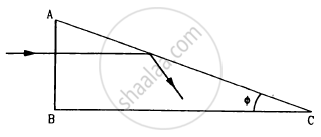
A light ray is incident normally on the face AB of a right-angled prism ABC (μ = 1.50) as shown in figure. What is the largest angle ϕ for which the light ray is totally reflected at the surface AC?
योग
Advertisements

उत्तर

Given,
Refractive index (μ) of prism = 1.50
Let us take θc as the critical angle for the glass.

So, According to Snell's law,
\[\frac{\sin  \theta_c}{\sin  90^\circ } = \frac{1}{\mu}\]
\[\Rightarrow \sin \theta c = \frac{1}{1 . 5} = \frac{2}{3}\]
\[\Rightarrow    \theta_c  =  \sin^{- 1} \frac{2}{3}\]
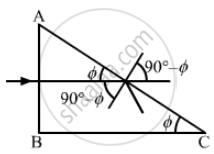
Condition for total internal reflection: 90° − \[\phi\] θ
⇒ \[\phi\] < 90°  - θc 
\[\Rightarrow    \theta_c  =  \sin^{- 1} \frac{2}{3}\] 
\[\Rightarrow \phi < \cos^{- 1} \left( \frac{2}{3} \right)\]

Hence, the largest angle for which light is totally reflected at the surface AC is \[\cos^{- 1} \left( \frac{2}{3} \right)\]
shaalaa.com
  क्या इस प्रश्न या उत्तर में कोई त्रुटि है?
अध्याय 18: Geometrical Optics - Exercise [पृष्ठ ४१४]

APPEARS IN

एचसी वर्मा Concepts of Physics Vol. 1 [English] Class 11 and 12
अध्याय 18 Geometrical Optics
Exercise | Q 27 | पृष्ठ ४१४

संबंधित प्रश्न

Use the mirror equation to deduce that the virtual image produced by a convex mirror is always diminished in size and is located between the focus and the pole.


Use the mirror equation to show that an object placed between f and 2f of a concave mirror forms an image beyond 2f.


Use the mirror equation to show a convex mirror always produces a virtual image independent of the location of the object ?


Can a plane mirror ever form a real image?


A point source of light is placed in front of a plane mirror.


A small object is placed at the centre of the bottom of a cylindrical vessel of radius 3 cm and height 4 cm filled completely with water. Consider the ray leaving the vessel through a corner. Suppose this ray and the ray along the axis of the vessel are used to trace the image. Find the apparent depth of the image and the ratio of real depth to the apparent depth under the assumptions taken. Refractive index of water = 1.33.


Find the angle of deviation suffered by the light ray shown in figure. The refractive index μ = 1.5 for the prism material.


Name the physical principle on which the working of optical fibers is based.


The figure below shows the positions of a point object O, two lenses, a plane mirror and the final image I which coincides with the object. The focal length of the convex lens is 20 cm. Calculate the focal length of the concave lens.


A parallel beam of light is allowed to fall on a transparent spherical globe of diameter 30cm and refractive index 1.5. The distance from the centre of the globe at which the beam of light can converge is ______ mm.


The focal length f is related to the radius of curvature r of the spherical convex mirror by ______.


Car B overtakes car A at a relative speed of 40 ms-1. How fast will the image of car B appear to move in the mirror of focal length 10 cm fitted in car A, when car B is 1.9 m away from car A?


When a clock is viewed in a mirror, the needles exhibit a time which appears to be 8:20. Then the actual time will be:


An upright object is placed at a distance of 40 cm in front of a convergent lens of a focal length of 20 cm. A convergent mirror of focal length 10 cm is placed at a distance of 60 cm on the other side of the lens. The position and size of the final image will be ______.


Two plane mirrors are inclined at an angle of 40°. The possible number of images of an object placed at point P would be?


Share
Notifications

Englishहिंदीमराठी


      Forgot password?
Use app×