Advertisements
Advertisements
प्रश्न
An optical fibre (μ = 1.72) is surrounded by a glass coating (μ = 1.50). Find the critical angle for total internal reflection at the fibre-glass interface.
Advertisements
उत्तर
Given,
Refractive index of the optical fibre is represented by μo = 1.72
Refractive index of glass coating is represented by μg= 1.50
Let the critical angle for glass be θc
Using the Snell's law,
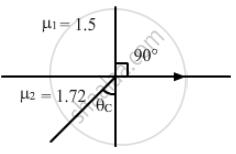
\[\frac{\sin i}{\sin r} = \frac{\sin \theta_c}{\sin 90^\circ } = \frac{\mu_g}{\mu_0}\]
\[ \Rightarrow \frac{\sin \theta_c}{\sin 90^\circ } = \frac{1 . 50}{1 . 72} = \frac{75}{86}\]
\[ \Rightarrow \theta_c = \sin^{- 1} \left( \frac{75}{86} \right)\]
Hence, the required critical angle is \[\sin^{- 1} \left( \frac{75}{86} \right)\]
APPEARS IN
संबंधित प्रश्न
Why can’t we see clearly through fog?
Show with the help of a diagram, how unpolarised light from Sun gets linearly polarised by scattering.
Write two points of difference between the phenomena of interference and diffraction.
In the meterbridge experimental set up, shown in the figure, the null point ‘D’ is obtained at a distance of 40 cm from end A of the meterbridge wire. If a resistance of 10Ω is connected in series with R1, null point is obtained at AD = 60 cm. Calculate the values of R1 and R2.
Describe briefly using a diagram how sunlight is polarised ?
The image formed by a concave mirror
A convex lens is made of a material having refractive index
\[1 \cdot 2\] Both the surfaces of the lens are convex. If it is dipped into water (μ = 1.33), it will behave like
A concave mirror forms an image of 20 cm high object on a screen placed 5.0 m away from the mirror. The height of the image is 50 cm. Find the focal length of the mirror and the distance between the mirror and the object.
A candle flame 1.6 cm high is imaged in a ball bearing of diameter 0.4 cm. If the ball bearing is 20 cm away from the flame, find the location and the height of the image.
A 3 cm tall object is placed at a distance of 7.5 cm from a convex mirror of focal length 6 cm. Find the location, size and nature of the image.
k transparent slabs are arranged one over another. The refractive indices of the slabs are μ1, μ2, μ3, ... μk and the thicknesses are t1 t2, t3, ... tk. An object is seen through this combination with nearly perpendicular light. Find the equivalent refractive index of the system which will allow the image to be formed at the same place.
A paperweight in the form of a hemisphere of radius 3.0 cm is used to hold down a printed page. An observer looks at the page vertically through the paperweight. At what height above the page will the printed letters near the centre appear to the observer?
Explain: ‘How is a rainbow formed’?
A plano-convex lens is made of material having refractive index 1.5. The radius of curvature of curved surface is 40 cm. The focal length of the lens is ____________ cm.
A parallel beam of light of wavelength 5890 Å falls normally on a slit of width 0.2 mm. Find the distance between the first minima on the two sides of the central maximum of the diffraction pattern observed on a screen placed in the focal plane of a convex lens of focal length 50 cm. The lens is placed quite close to the slit.
A short pulse of white light is incident from air to a glass slab at normal incidence. After travelling through the slab, the first colour to emerge is ______.
A passenger in an aeroplane shall ______.
