Advertisements
Advertisements
प्रश्न
Answer the following question in detail.
State the conditions under which a rainbow can be seen.
Advertisements
उत्तर
A rainbow can be observed when there is a light shower with a relatively large raindrop occurring during morning or evening time with enough sunlight around.
APPEARS IN
संबंधित प्रश्न
Give a scientific reason:
Danger signal lights are red in colour.
Name the phenomenon responsible for it.
Show with the help of a diagram, how unpolarised light from Sun gets linearly polarised by scattering.
What is linearly polarized light?
Describe briefly using a diagram how sunlight is polarised ?
Suppose you are inside the water in a swimming pool near an edge. A friends is standing on the edge. Do you find your friend taller or shorter than his usual height?
The image formed by a concave mirror
A thin lens is made with a material having refractive index
\[\mu = 1 \cdot 5\]. Both the side are convex. It is dipped in water \[\mu = 1 \cdot 33\]. It will behave like
A convex lens is made of a material having refractive index
\[1 \cdot 2\] Both the surfaces of the lens are convex. If it is dipped into water (μ = 1.33), it will behave like
A point object O is placed on the principal axis of a convex lens of focal length f = 20 cm at a distance of 40 cm to the left of it. The diameter of the lens is 10 cm. An eye is placed 60 cm to right of the lens and a distance h below the principal axis. The maximum value of h to see the image is
A concave mirror forms an image of 20 cm high object on a screen placed 5.0 m away from the mirror. The height of the image is 50 cm. Find the focal length of the mirror and the distance between the mirror and the object.
A concave mirror has a focal length of 20 cm. Find the position or positions of an object for which the image-size is double of the object-size.
A 1 cm object is placed perpendicular to the principal axis of a convex mirror of focal length 7.5 cm. Find its distance from the mirror if the image formed is 0.6 cm in size.
A point source S is placed midway between two converging mirrors having equal focal length f as shown in figure. Find the values of d for which only one image is formed.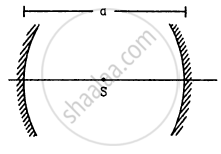
Locate the image of the point P as seen by the eye in the figure.
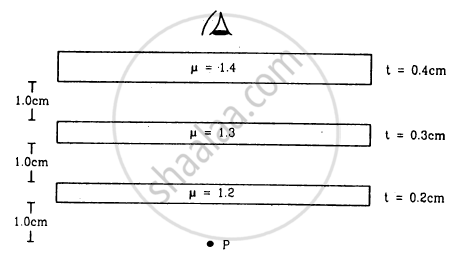
Light falls from glass (μ = 1.5) to air. Find the angle of incidence for which the angle of deviation is 90°.
A point source is placed at a depth h below the surface of water (refractive index = μ). (a) Show that light escapes through a circular area on the water surface with its centre directly above the point source. (b) Find the angle subtended by a radius of the area on the source.
The diameter of the sun is 1.4 × 10⁹ m and its distance from the earth is 1.5 × 10¹¹ m. Find the radius of the image of the sun formed by a lens of focal length 20 cm.
Pick the wrong answer in the context with rainbow.
Rainbow is the phenomenon due to ______.
A plano-convex lens is made of material having refractive index 1.5. The radius of curvature of curved surface is 40 cm. The focal length of the lens is ____________ cm.
Explain the formation of primary and secondary rainbow.
| Case study: Mirage in deserts |
 |
|
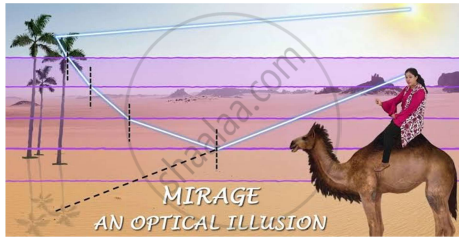
To a distant observer, the light appears to be coming from somewhere below the ground. The observer naturally assumes that light is being reflected from the ground, say, by a pool of water near the tall object. Such inverted images of distant tall objects cause an optical illusion to the observer. This phenomenon is called mirage. This type of mirage is especially common in hot deserts. Based on the above facts, answer the following question : |
In an optical fibre, if n1 and n2 are the refractive indices of the core and cladding, then which among the following, would be a correct equation?
| Case study: Mirage in deserts |
|
|
To a distant observer, the light appears to be coming from somewhere below the ground. The observer naturally assumes that light is being reflected from the ground, say, by a pool of water near the tall object. Such inverted images of distant tall objects cause an optical illusion to the observer. This phenomenon is called mirage. This type of mirage is especially common in hot deserts. Based on the above facts, answer the following question: |
A diamond is immersed in such a liquid which has its refractive index with respect to air as greater than the refractive index of water with respect to air. Then the critical angle of diamond-liquid interface as compared to critical angle of diamond-water interface will
| Case study: Mirage in deserts |
|
|
To a distant observer, the light appears to be coming from somewhere below the ground. The observer naturally assumes that light is being reflected from the ground, say, by a pool of water near the tall object. Such inverted images of distant tall objects cause an optical illusion to the observer. This phenomenon is called mirage. This type of mirage is especially common in hot deserts. Based on the above facts, answer the following question: |
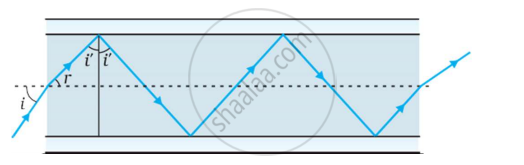
The following figure shows a cross-section of a ‘light pipe’ made of a glass fiber of refractive index 1.68. The outer covering of the pipe is made of a material of refractive index 1.44. What is the range of the angles of the incident rays with the axis of the pipe for the following phenomena to occur.
Between the primary and secondary rainbows, there is a dark band known as Alexandar’s dark band. This is because ______.
- light scattered into this region interfere destructively.
- there is no light scattered into this region.
- light is absorbed in this region.
- angle made at the eye by the scattered rays with respect to the incident light of the sun lies between approximately 42° and 50°.
