हिंदी

Case study: Mirage in deserts To a distant observer, the light appears to be coming from somewhere below the ground. The observer naturally - Physics

Advertisements
Advertisements

प्रश्न

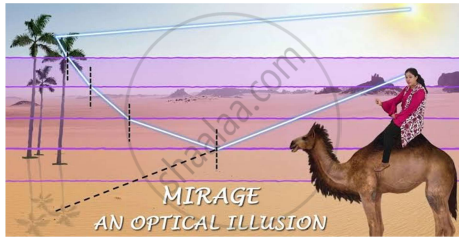
Case study: Mirage in deserts 

To a distant observer, the light appears to be coming from somewhere below the ground. The observer naturally assumes that light is being reflected from the ground, say, by a pool of water near the tall object.

Such inverted images of distant tall objects cause an optical illusion to the observer. This phenomenon is called mirage. This type of mirage is especially common in hot deserts.

Based on the above facts, answer the following question:

A diamond is immersed in such a liquid which has its refractive index with respect to air as greater than the refractive index of water with respect to air. Then the critical angle of diamond-liquid interface as compared to critical angle of diamond-water interface will

विकल्प

  • depend on the nature of the liquid only

  • decrease

  • remain the same

  • increase

MCQ
Advertisements

उत्तर

increase

Explanation -

`1_(mu"d") = 1/(sin "C") = (mu_"d")/(mu_1)`, `ω_(mu"d") = 1/(sin "C'") = (mu_"d")/(mu_ω)`

µ1 > µω

Thus C > C'

shaalaa.com
  क्या इस प्रश्न या उत्तर में कोई त्रुटि है?
2021-2022 (March) Term 2 Sample

संबंधित प्रश्न

Name the phenomenon responsible for it.


 Write two points of difference between the phenomena of interference and diffraction.


Describe briefly using a diagram how sunlight is polarised ?


Suppose you are inside the water in a swimming pool near an edge. A friends is standing on the edge. Do you find your friend taller or shorter than his usual height?


A candle flame 1.6 cm high is imaged in a ball bearing of diameter 0.4 cm. If the ball bearing is 20 cm away from the flame, find the location and the height of the image.


Light falls from glass (μ = 1.5) to air. Find the angle of incidence for which the angle of deviation is 90°.


The diameter of the sun is 1.4 × 10⁹ m and its distance from the earth is 1.5 × 10¹¹ m. Find the radius of the image of the sun formed by a lens of focal length 20 cm.


Answer the following question in detail.

Explain the formation of a secondary rainbow. For which angular range with the horizontal is it visible?


Answer the following question in detail.

Is it possible to see primary and secondary rainbow simultaneously? Under what conditions?


Case study: Mirage in deserts

To a distant observer, the light appears to be coming from somewhere below the ground. The observer naturally assumes that light is being reflected from the ground, say, by a pool of water near the tall object.

Such inverted images of distant tall objects cause an optical illusion to the observer. This phenomenon is called mirage. This type of mirage is especially common in hot deserts.

Based on the above facts, answer the following question :

In an optical fibre, if n1 and n2 are the refractive indices of the core and cladding, then which among the following, would be a correct equation? 


Share
Notifications

Englishहिंदीमराठी


      Forgot password?
Use app×