Advertisements
Advertisements
प्रश्न
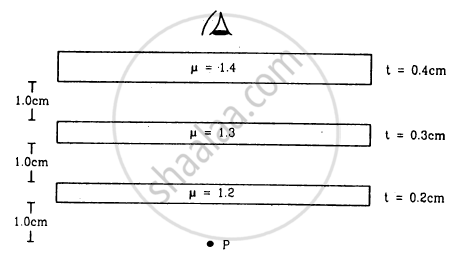
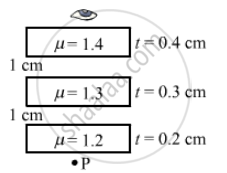
Locate the image of the point P as seen by the eye in the figure.
Advertisements
उत्तर
Given,
From the figure we can infer that the air is present in between the sheet, so it does not affect the shift. Therefore, the shift is only due to 3 sheets of different refractive indices, which is given by:
\[∆ t = \left[ 1 - \frac{1}{\mu_1} \right] t_1 + \left[ 1 - \frac{1}{\mu_2} \right] t_2 + \left[ 1 - \frac{1}{\mu_3} \right] t_3\]
\[= \left[ 1 - \left( \frac{1}{12} \right) \right]\left( 0 . 2 \right) + \left[ 1 - \left( \frac{1}{1 . 3} \right) \right]\left( 0 . 3 \right) + \left[ 1 - \left( \frac{1}{1 . 4} \right) \right]\left( 0 . 4 \right)\]
= 0.2 cm
Hence, location of image of point P is located 0.2 cm above point P.
APPEARS IN
संबंधित प्रश्न
Why can’t we see clearly through fog?
Why does unpolarised light from a source show a variation in intensity when viewed through a polaroid which is rotated?
Show with the help of a diagram, how unpolarised light from Sun gets linearly polarised by scattering.
Draw the intensity distribution for the diffraction bands produced due to single slit ?
Why does the Sun look reddish at sunset or sunrise ?
The image formed by a concave mirror
A parallel beam of light is incident on a converging lens parallel to its principal axis. As one moves away from the lens on the other side on its principal axis, the intensity of light
A convex lens is made of a material having refractive index
\[1 \cdot 2\] Both the surfaces of the lens are convex. If it is dipped into water (μ = 1.33), it will behave like
A concave mirror has a focal length of 20 cm. Find the position or positions of an object for which the image-size is double of the object-size.
A 1 cm object is placed perpendicular to the principal axis of a convex mirror of focal length 7.5 cm. Find its distance from the mirror if the image formed is 0.6 cm in size.
A cylindrical vessel, whose diameter and height both are equal to 30 cm, is placed on a horizontal surface and a small particle P is placed in it at a distance of 5.0 cm from the centre. An eye is placed at a position such that the edge of the bottom is just visible (see figure). The particle P is in the plane of drawing. Up to what minimum height should water be poured in the vessel to make the particle P visible?

Light is incident from glass (μ = 1.50) to water (μ = 1.33). Find the range of the angle of deviation for which there are two angles of incidence.
Explain: ‘How is a rainbow formed’?
Answer the following question in detail.
State the conditions under which a rainbow can be seen.
Answer the following question in detail.
Explain the formation of a primary rainbow. For which angular range with the horizontal is it visible?
Answer the following question in detail.
Is it possible to see primary and secondary rainbow simultaneously? Under what conditions?
Explain the formation of primary and secondary rainbow.
Between the primary and secondary rainbows, there is a dark band known as Alexandar’s dark band. This is because ______.
- light scattered into this region interfere destructively.
- there is no light scattered into this region.
- light is absorbed in this region.
- angle made at the eye by the scattered rays with respect to the incident light of the sun lies between approximately 42° and 50°.
