Advertisements
Advertisements
प्रश्न
Answer the following question in detail.
Explain the formation of a secondary rainbow. For which angular range with the horizontal is it visible?
Advertisements
उत्तर
- A ray AB incident from Sun (white light) strikes the lower portion of a water drop at an incident angle i.
- On entering into the water, it deviates and disperses into constituent colours. The figure shows the extreme colours (violet and red).

Formation of secondary rainbow - Refracted rays BV and BR finally emerge the drop from V' and R' after suffering two internal reflections and can be seen by an observer on the ground.
- Minimum deviation rays of red and violet colour are inclined to the ground level at θR ≈ 51° and θV ≈ 53° respectively. As a result, in the rainbow, the violet is above and red is below.
APPEARS IN
संबंधित प्रश्न
Why can’t we see clearly through fog?
Name the phenomenon responsible for it.
Draw the intensity distribution for the fringes produced in interference ?
Write two points of difference between the phenomena of interference and diffraction.
Why does the Sun look reddish at sunset or sunrise ?
In the meterbridge experimental set up, shown in the figure, the null point ‘D’ is obtained at a distance of 40 cm from end A of the meterbridge wire. If a resistance of 10Ω is connected in series with R1, null point is obtained at AD = 60 cm. Calculate the values of R1 and R2.
Suppose you are inside the water in a swimming pool near an edge. A friends is standing on the edge. Do you find your friend taller or shorter than his usual height?
The image formed by a concave mirror
A thin lens is made with a material having refractive index
\[\mu = 1 \cdot 5\]. Both the side are convex. It is dipped in water \[\mu = 1 \cdot 33\]. It will behave like
A point object O is placed on the principal axis of a convex lens of focal length f = 20 cm at a distance of 40 cm to the left of it. The diameter of the lens is 10 cm. An eye is placed 60 cm to right of the lens and a distance h below the principal axis. The maximum value of h to see the image is
A concave mirror having a radius of curvature 40 cm is placed in front of an illuminated point source at a distance of 30 cm from it. Find the location of the image.
A concave mirror has a focal length of 20 cm. Find the position or positions of an object for which the image-size is double of the object-size.
A 1 cm object is placed perpendicular to the principal axis of a convex mirror of focal length 7.5 cm. Find its distance from the mirror if the image formed is 0.6 cm in size.
A candle flame 1.6 cm high is imaged in a ball bearing of diameter 0.4 cm. If the ball bearing is 20 cm away from the flame, find the location and the height of the image.
A 3 cm tall object is placed at a distance of 7.5 cm from a convex mirror of focal length 6 cm. Find the location, size and nature of the image.
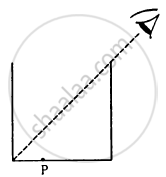
A cylindrical vessel, whose diameter and height both are equal to 30 cm, is placed on a horizontal surface and a small particle P is placed in it at a distance of 5.0 cm from the centre. An eye is placed at a position such that the edge of the bottom is just visible (see figure). The particle P is in the plane of drawing. Up to what minimum height should water be poured in the vessel to make the particle P visible?
An optical fibre (μ = 1.72) is surrounded by a glass coating (μ = 1.50). Find the critical angle for total internal reflection at the fibre-glass interface.
Light is incident from glass (μ = 1.50) to water (μ = 1.33). Find the range of the angle of deviation for which there are two angles of incidence.
Explain: ‘How is a rainbow formed’?
Answer the following question in detail.
State the conditions under which a rainbow can be seen.
Answer the following question in detail.
Explain the formation of a primary rainbow. For which angular range with the horizontal is it visible?
Explain the formation of primary and secondary rainbow.
| Case study: Mirage in deserts |
 |
|
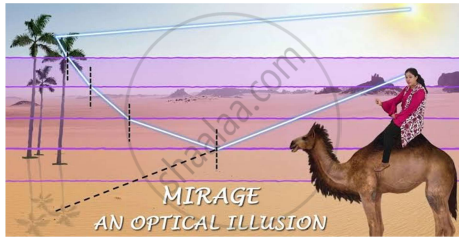
To a distant observer, the light appears to be coming from somewhere below the ground. The observer naturally assumes that light is being reflected from the ground, say, by a pool of water near the tall object. Such inverted images of distant tall objects cause an optical illusion to the observer. This phenomenon is called mirage. This type of mirage is especially common in hot deserts. Based on the above facts, answer the following question: |
Which of the following phenomena is prominently involved in the formation of mirage in deserts?
| Case study: Mirage in deserts |
|
|
To a distant observer, the light appears to be coming from somewhere below the ground. The observer naturally assumes that light is being reflected from the ground, say, by a pool of water near the tall object. Such inverted images of distant tall objects cause an optical illusion to the observer. This phenomenon is called mirage. This type of mirage is especially common in hot deserts. Based on the above facts, answer the following question : |
In an optical fibre, if n1 and n2 are the refractive indices of the core and cladding, then which among the following, would be a correct equation?
| Case study: Mirage in deserts |
|
|
To a distant observer, the light appears to be coming from somewhere below the ground. The observer naturally assumes that light is being reflected from the ground, say, by a pool of water near the tall object. Such inverted images of distant tall objects cause an optical illusion to the observer. This phenomenon is called mirage. This type of mirage is especially common in hot deserts. Based on the above facts, answer the following question: |
A diamond is immersed in such a liquid which has its refractive index with respect to air as greater than the refractive index of water with respect to air. Then the critical angle of diamond-liquid interface as compared to critical angle of diamond-water interface will
A short pulse of white light is incident from air to a glass slab at normal incidence. After travelling through the slab, the first colour to emerge is ______.
A passenger in an aeroplane shall ______.
