मराठी
कर्नाटक बोर्ड पी.यू.सी.पीयूसी विज्ञान इयत्ता ११

One End of a Cylindrical Glass Rod (μ = 1.5) of Radius 1.0 Cm is Rounded in the Shape of a Hemisphere. the Rod is Immersed in Water (μ = 4/3) and an Object is - Physics

Advertisements
Advertisements

प्रश्न

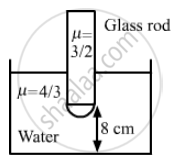
One end of a cylindrical glass rod (μ = 1.5) of radius 1.0 cm is rounded in the shape of a hemisphere. The rod is immersed in water (μ = 4/3) and an object is placed in the water along the axis of the rod at a distance of 8.0 cm from the rounded edge. Locate the image of the object.

बेरीज
Advertisements

उत्तर

Given,
Radius (R) of the cylindrical rod = 1.0 cm
Refractive index (μg) of the rod = 1.5 = \[\frac{3}{2}\] Refractive index (μw) of water = 4/3 
\[\frac{\mu_g}{v} - \frac{\mu_w}{u} = \frac{\mu_g - \mu_w}{R}\]
As per the question, u = −8 cm.
Now,

\[\frac{3}{2v} - \left( - \frac{4}{3 \times 8} \right) = \frac{\frac{3}{2} - \frac{4}{3}}{1}\] 

\[ \Rightarrow \frac{3}{2v} + \frac{1}{6} = \frac{1}{6}\] 

\[ \Rightarrow v =  \infty\]
Hence, the image will be formed at infinity (∞).

shaalaa.com
  या प्रश्नात किंवा उत्तरात काही त्रुटी आहे का?
पाठ 18: Geometrical Optics - Exercise [पृष्ठ ४१५]

APPEARS IN

एचसी वर्मा Concepts of Physics Vol. 1 [English] Class 11 and 12
पाठ 18 Geometrical Optics
Exercise | Q 43 | पृष्ठ ४१५

संबंधित प्रश्‍न

Name the phenomenon responsible for it.


Why does unpolarised light from a source show a variation in intensity when viewed through a polaroid which is rotated?


Show with the help of a diagram, how unpolarised light from Sun gets linearly polarised by scattering.


 Write two points of difference between the phenomena of interference and diffraction.


What is linearly polarized light? 


A thin lens is made with a material having refractive index
\[\mu = 1 \cdot 5\]. Both the side are convex. It is dipped in water \[\mu = 1 \cdot 33\]. It will behave like


A convex lens is made of a material having refractive index
\[1 \cdot 2\] Both the surfaces of the lens are convex. If it is dipped into water (μ = 1.33), it will behave like 


A candle flame 1.6 cm high is imaged in a ball bearing of diameter 0.4 cm. If the ball bearing is 20 cm away from the flame, find the location and the height of the image.


A cylindrical vessel, whose diameter and height both are equal to 30 cm, is placed on a horizontal surface and a small particle P is placed in it at a distance of 5.0 cm from the centre. An eye is placed at a position such that the edge of the bottom is just visible (see figure). The particle P is in the plane of drawing. Up to what minimum height should water be poured in the vessel to make the particle P visible?


A container contains water up to a height of 20 cm and there is a point source at the centre of the bottom of the container. A rubber ring of radius r floats centrally on the water. The ceiling of the room is 2.0 m above the water surface. (a) Find the radius of the shadow of the ring formed on the ceiling if r = 15 cm. (b) Find the maximum value of r for which the shadow of the ring is formed on the ceiling. Refractive index of water = 4/3.


A paperweight in the form of a hemisphere of radius 3.0 cm is used to hold down a printed page. An observer looks at the page vertically through the paperweight. At what height above the page will the printed letters near the centre appear to the observer?


Explain: ‘How is a rainbow formed’?


Answer the following question in detail.

State the conditions under which a rainbow can be seen.


State any one difference between a primary rainbow and a secondary rainbow.


Explain the formation of primary and secondary rainbow.


A short pulse of white light is incident from air to a glass slab at normal incidence. After travelling through the slab, the first colour to emerge is ______.


A passenger in an aeroplane shall ______.


Share
Notifications

Englishहिंदीमराठी


      Forgot password?
Use app×