मराठी
कर्नाटक बोर्ड पी.यू.सी.पीयूसी विज्ञान इयत्ता ११

A Paperweight in the Form of a Hemisphere of Radius 3.0 Cm is Used to Hold Down a Printed Page. an Observer Looks at the Page Vertically Through the - Physics

Advertisements
Advertisements

प्रश्न

A paperweight in the form of a hemisphere of radius 3.0 cm is used to hold down a printed page. An observer looks at the page vertically through the paperweight. At what height above the page will the printed letters near the centre appear to the observer?

बेरीज
Advertisements

उत्तर

Given:
Radius of the paperweight (R) = 3 cm
Refractive index of the paperweight (μ2) = 3/2
Refractive index of the air (μ1) = 1
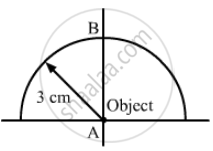
In the first case, the refraction is at A.
u = 0 and R = ∞
We know:

\[\frac{\mu_2}{v} - \frac{\mu_1}{u} = \frac{\mu_2 - \mu_1}{R}\] 

\[ \Rightarrow \frac{\frac{3}{2}}{v} - \frac{1}{0} = \frac{\mu_2 - \mu_1}{\infty}\] 

\[ \Rightarrow v = 0\]
Therefore, the image of the letter is formed at the point.
For the second case, refraction is at point B.
Here,
Object distance, = −3 cm
= − 3 cm
μ1 = 3/2
μ2 = 1
Thus, we have:

\[\frac{\mu_2}{v} - \frac{\mu_1}{u} = \frac{\mu_2 - \mu_1}{R}\] 

\[\frac{1}{v} - \frac{3}{2 \times ( - 3)} = \frac{1 - \frac{3}{2}}{- 3}\] 

\[ \Rightarrow \frac{1}{v} + \frac{3}{2 \times 3} = \frac{1}{6}\] 

\[ \Rightarrow \frac{1}{v} = \frac{1}{6} - \frac{1}{2}\] 

\[ \Rightarrow v =  - 3  \text{ cm }\]
Hence, there will be no shift in the final image.

shaalaa.com
  या प्रश्नात किंवा उत्तरात काही त्रुटी आहे का?
पाठ 18: Geometrical Optics - Exercise [पृष्ठ ४१५]

APPEARS IN

एचसी वर्मा Concepts of Physics Vol. 1 [English] Class 11 and 12
पाठ 18 Geometrical Optics
Exercise | Q 44 | पृष्ठ ४१५

संबंधित प्रश्‍न

Draw the intensity distribution for the diffraction bands produced due to single slit ?


In the meterbridge experimental set up, shown in the figure, the null point ‘D’ is obtained at a distance of 40 cm from end A of the meterbridge wire. If a resistance of 10Ω is connected in series with R1, null point is obtained at AD = 60 cm. Calculate the values of R1 and R2.


What is linearly polarized light? 


A thin lens is made with a material having refractive index
\[\mu = 1 \cdot 5\]. Both the side are convex. It is dipped in water \[\mu = 1 \cdot 33\]. It will behave like


A concave mirror has a focal length of 20 cm. Find the position or positions of an object for which the image-size is double of the object-size.


A candle flame 1.6 cm high is imaged in a ball bearing of diameter 0.4 cm. If the ball bearing is 20 cm away from the flame, find the location and the height of the image.


A 3 cm tall object is placed at a distance of 7.5 cm from a convex mirror of focal length 6 cm. Find the location, size and nature of the image.


A converging mirror M1, a point source S and a diverging mirror M2 are arranged as shown in figure. The source is placed at a distance of 30 cm from M1. The focal length of each of the mirrors is 20 cm. Consider only the images formed by a maximum of two reflections. It is found that one image is formed on the source itself. (a) Find the distance between the two mirrors. (b) Find the location of the image formed by the single reflection from M2.


Locate the image of the point P as seen by the eye in the figure.


A cylindrical vessel, whose diameter and height both are equal to 30 cm, is placed on a horizontal surface and a small particle P is placed in it at a distance of 5.0 cm from the centre. An eye is placed at a position such that the edge of the bottom is just visible (see figure). The particle P is in the plane of drawing. Up to what minimum height should water be poured in the vessel to make the particle P visible?


An optical fibre (μ = 1.72) is surrounded by a glass coating (μ = 1.50). Find the critical angle for total internal reflection at the fibre-glass interface.


Light is incident from glass (μ = 1.50) to water (μ = 1.33). Find the range of the angle of deviation for which there are two angles of incidence.


A point source is placed at a depth h below the surface of water (refractive index = μ). (a) Show that light escapes through a circular area on the water surface with its centre directly above the point source. (b) Find the angle subtended by a radius of the area on the source.


A container contains water up to a height of 20 cm and there is a point source at the centre of the bottom of the container. A rubber ring of radius r floats centrally on the water. The ceiling of the room is 2.0 m above the water surface. (a) Find the radius of the shadow of the ring formed on the ceiling if r = 15 cm. (b) Find the maximum value of r for which the shadow of the ring is formed on the ceiling. Refractive index of water = 4/3.


Rainbow is the phenomenon due to ______.


A plano-convex lens is made of material having refractive index 1.5. The radius of curvature of curved surface is 40 cm. The focal length of the lens is ____________ cm.


State any one difference between a primary rainbow and a secondary rainbow.


A passenger in an aeroplane shall ______.


Between the primary and secondary rainbows, there is a dark band known as Alexandar’s dark band. This is because ______.

  1. light scattered into this region interfere destructively.
  2. there is no light scattered into this region.
  3. light is absorbed in this region.
  4. angle made at the eye by the scattered rays with respect to the incident light of the sun lies between approximately 42° and 50°.

Share
Notifications

Englishहिंदीमराठी


      Forgot password?
Use app×