Advertisements
Advertisements
Question
If an object is placed in front of a convex lens beyond 2F1, then what will be the position, relative size, and nature of an image which is formed? Explain with a ray diagram.
Advertisements
Solution

APPEARS IN
RELATED QUESTIONS
A student places a candle flame at a distance of about 60 cm from a convex lens of focal length 10 cm and focuses the image of the flame on a screen. After that he gradually moves the flame towards the lens and each time focuses the image on the screen.
(a) In which direction-toward or away from the lens, does he move the screen to focus the image?
(b) How does the size of the image change?
(c) How does the intensity of the image change as the flame moves towards the lens?
(d) Approximately for what distance between the flame and the lens, the image formed on the screen is inverted and of the same size?
An object is placed at a distance of 15 cm from a convex lens of focal length 20 cm. List four characteristics (nature, position, etc.) of the image formed by the lens.
An object is placed at a distance of 15 cm from a concave lens of focal length 30 cm. List four characteristics (nature, position, etc.) of the image formed by the lens.
Where should an object be placed so that a real and inverted image of the same size as the object is obtained using a convex lens?
An object of height 4.0 cm is placed at a distance of 30 cm from the optical centre 'O' of a convex lens of focal length 20 cm. Draw a ray diagram to find the position and size of the image formed. Mark optical centre 'O' and principal focus 'F' on the diagram. Also find the approximate ratio of size of the image to the size of the object.
Draw a labelled ray diagram to show how a ray of light passes through a parallel-sided glass block if it hits the glass block at 90° (that is, perpendicular to the glass block).
If an object is at a considerable distance (or infinity) in front of a convex lens, where is the image formed?
You eye contains a convex lens. Why is it unwise to look at the sun?
Find the position and nature of the image of an object 5 cm high and 10 cm in front of a convex lens of focal length 6 cm.
- An object 3 cm high is placed 24 cm away from a convex lens of focal length 8 cm. Find by calculations, the position, height and nature of the image.
- If the object is moved to a point only 3 cm away from the lens, what is the new position, height and nature of the image?
- Which of the above two cases illustrates the working of a magnifying glass?
Find the nature, position and magnification of the images formed by a convex lens of focal length 0.20 m if the object is placed at a distance of:
0.15 m
What type of images can a convex lens make?
The given below figure shows an object OA and its image IB formed by a lens
. 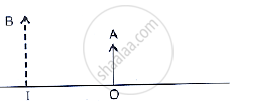
draw suitable rays to locate the lens and its focus.
For finding the focal length of a convex lens by obtaining the image of a distant object, one should use as the object.
(1) a well lit distant tree
(2) window grill in the class room
(3) any distant tree
(4) a lighted candle kept at the other end of the table.
A lens always forms an image between the object and the lens.
A lens always forms an image between the object and the lens.
Answer the following question.
List four precautions which a student should observe while determining the focal length of a given convex lens by obtaining an image of a distant object on a screen.
How will you determine the focal length of a convex lens by the plane mirror method?
Simple microscope : Number of convex lens one : : compound microscope : _______
Distinguish between:
Concave lens and Convex Lens
