Advertisements
Advertisements
Question
Simple microscope : Number of convex lens one : : compound microscope : _______
Advertisements
Solution
Simple microscope : Number of convex lens one : : compound microscope : Number of convex lenses two
APPEARS IN
RELATED QUESTIONS
If you focus the image of a distant object, whose shape is given below, on a screen using a convex lens, the shape of the image of this object on the screen would be:
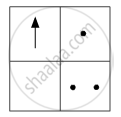
(a)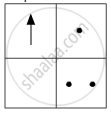
(b)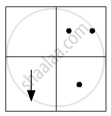
(c)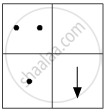
(d)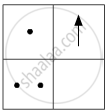
A student places a candle flame at a distance of about 60 cm from a convex lens of focal length 10 cm and focuses the image of the flame on a screen. After that he gradually moves the flame towards the lens and each time focuses the image on the screen.
(a) In which direction-toward or away from the lens, does he move the screen to focus the image?
(b) How does the size of the image change?
(c) How does the intensity of the image change as the flame moves towards the lens?
(d) Approximately for what distance between the flame and the lens, the image formed on the screen is inverted and of the same size?
An object is placed at a distance of 15 cm from a concave lens of focal length 30 cm. List four characteristics (nature, position, etc.) of the image formed by the lens.
Draw a labelled ray diagram to show how a ray of light is refracted when it passes:
from an optically denser medium into air.
Draw a labelled ray diagram to show the angle of incidence and the angle of refraction for a refracted ray of light.
An object is placed f and 2f of a convex lens. Which of the following statements correctly describes its image?
(a) real, larger than the object
(b) erect, smaller than the object
(c) inverted, same size as object
(d) virtual, larger than the object
A convex lens of focal length 6 cm is held 4 cm from a newspaper which has print 0.5 cm high. By calculation, determine the size and nature of the image produced.
A student did an experiment with a convex lens. He put an object at different distances 25 cm, 30 cm, 40 cm, 60 cm and 120 cm from the lens. In each case he measured the distance of the image from the lens. His results were 100 cm, 24 cm, 60 cm, 30 cm and 40 cm, respectively. Unfortunately his results are written in wrong order.
Which of the object distances gives the biggest image?
What kind of lens is used to correct
long-sightedness?
In a certain murder investigation, it was important to discover whether the victim was long-sighted or short-sighted. How could a detective decide by examining his spectacles?
Study the diagram below.
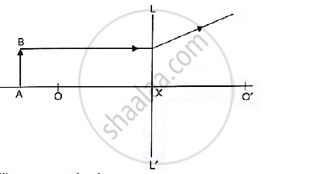
what are the points O, O’ called?
A convex lens has a divergent action and a concave lens has a convergent action.
Observe the following figure and answer the questions.

a) Which optical instrument shows arrangement of lenses as shown in the figure?
b) Write in brief the working of this optical instrument.
c) How can we get different magnifications in this optical instrument?
d) Draw the figure again and labelled it properly
Draw neat diagram to show the
Convergent action of a convex lens,
The focal length of a lens is positive. In this case, state the kind of lens.
Why do we say that the ‘2F’ and ‘F’ points of a convex lens can be regarded as a sort of ‘turning points’ as far as the nature of the image formed by it is concerned?
In the figure given below L is a convex lens, M is a plane mirror and S is a point source of light. Rays of light from the source S return to their point of origin. Complete the ray diagram to show this. What is the point S called?
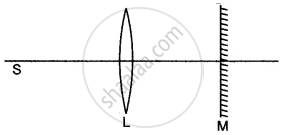
Diagram shows an object AB placed on the principal axis B of a convex lens placed in air. F1 and F2 are the two foci of the lens.
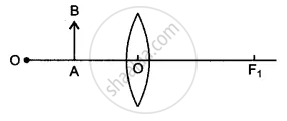
(i) Copy the diagram:
Draw a ray of light starting from B and passing through O. Show the same ray after refraction by the lens. Draw another ray from B which passes through F2 after refraction by the lens. Locate the final image
(ii) Is the image real or virtual?
