Advertisements
Advertisements
प्रश्न
Simple microscope : Number of convex lens one : : compound microscope : _______
Advertisements
उत्तर
Simple microscope : Number of convex lens one : : compound microscope : Number of convex lenses two
APPEARS IN
संबंधित प्रश्न
A ray of light travelling in air is incident on a parallel-sided glass slab (or rectangular glass slab). Draw a ray-diagram indicating the change in its path in glass.
Draw a labelled ray diagram to show how a ray of light is refracted when it passes:
from air into an optically denser medium.
The diagram given alongside shows a ray of light entering a rectangular block of glass.
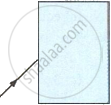
- Copy the diagram and draw the normal at the point of entry.
- Draw the approximate path of the ray of light through the glass block and out of the other side.
What type of lens would you use as a magnifying glass? How close must the object be to the lens?
Describe with the help of a ray diagram the nature, size and position of the image formed when an object is placed in front of a convex lens between focus and optical centre. State three characteristics of the image formed.
How could you find the focal length of a convex lens rapidly but approximately?
A convex lens of focal length 0.10 m is used to form a magnified image of an object of height 5 mm placed at a distance of 0.08 m from the lens. Calculate the position, nature and size of the image.
What kind of lens can form:
an inverted diminished image?
In figure , name the ray which represents the correct path of light while emerging out through
a glass block.
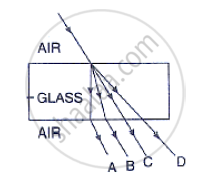
A light ray does not bend at the boundary in passing from one medium to the other medium if the angle of incident is:
The diagrams (a) and (b) in Figure below show the refraction of a monochromatic ray of light through a parallel sided glass block and a prism respectively. In each diagram, label the incident, refracted emergent rays and the angle of deviation.

A convex lens is placed in water. Its focal length will ______.
A student places a 8.0 cm tall object perpendicular to the principal axis of a convex lens of focal length 20 cm. The distance of the object from the lens is 30 cm. He obtains a sharp image of the object on a screen placed on the other side of the lens. What will be the nature (inverted, erect, magnified, diminished) of the image he obtains on a screen? Draw ray diagram to justify your answer.
A lens always forms an image between the object and the lens.
A lens always forms an image between the object and the lens.
A concave mirror and convex lens are held in water. What changes, if any, do you expect in their focal length?
Why do we say that the ‘2F’ and ‘F’ points of a convex lens can be regarded as a sort of ‘turning points’ as far as the nature of the image formed by it is concerned?
We can burn a piece of paper by focussing the sun rays by using a particular type of lens. Name the type of lens used for the above purpose. Draw a ray diagram to support your answer.
Object at 2F1 of a convex lens : Image at 2F2 : : Object at F1 : _______
 |
 |
The above images are that of a specialized slide projector. Slides are small transparencies mounted in sturdy frames ideally suited to magnification and projection since they have a very high resolution and a high image quality. There is a tray where the slides are to be put into a particular orientation so that the viewers can see the enlarged erect images of the transparent slides. This means that the slides will have to be inserted upside down in the projector tray.
To show her students the images of insects that she investigated in the lab, Mrs. Iyer brought a slide projector. Her slide projector produced 500 times enlarged and inverted image of a slide on a screen 10 m away.
a. Based on the text and data given in the above paragraph, what kind of lens must the slide projector have?
b. If v is the symbol used for image distance and u for object distance then with one reason state what will be the sign for `"𝑣"/"𝑢"` in the given case?
c. A slide projector has a convex lens with a focal length of 20 cm. The slide is placed upside down 21 cm from the lens. How far away should the screen be placed from the slide projector’s lens so that the slide is in focus?
OR
c. When a slide is placed 15 cm behind the lens in the projector, an image is formed 3 m in front of the lens. If the focal length of the lens is 14 cm, draw a ray diagram to show image formation. (not to scale)
