Advertisements
Advertisements
प्रश्न
Write scientific reason.
Adults need bifocal lens spectacle.
Advertisements
उत्तर
- The ability of the ciliary muscles near the eye lens to change the focal length of the lens decreases with age.
- As a result, sometimes adults suffer from both nearsightedness and farsightedness.
Therefore, adults need bifocal lens spectacle.
APPEARS IN
संबंधित प्रश्न
Draw a ray diagram to show the formation of image in the above situation
One-half of a convex lens is covered with a black paper. Will this lens produce a complete image of the object? Verify your answer experimentally. Explain your observations.
Analyse the following observation table showing variation of image-distance (v) with object-distance (u) in case of a convex lens and answer the questions that follow without doing any calculations :
| S. No. | Object-Distance u (cm) |
Image-Distance v (cm) |
| 1 | –100 | +25 |
| 2 | –60 | +30 |
| 3 | –40 | +40 |
| 4 | –30 | +60 |
| 5 | –25 | +100 |
| 6 | –15 | +120 |
(a) What is the focal length of the convex lens? Give reason to justify your answer.
(b) Write the serial number of the observation which is not correct. On what basis have you arrived at this conclusion?
(c) Select an appropriate scale and draw a ray diagram for the observation at S.No. 2. Also find the approximate value of magnification.
An object is placed f and 2f of a convex lens. Which of the following statements correctly describes its image?
(a) real, larger than the object
(b) erect, smaller than the object
(c) inverted, same size as object
(d) virtual, larger than the object
An object 2 cm tall is placed on the axis of a convex lens of focal length 5 cm at a distance of 10 m from the optical centre of the lens. Find the nature, position and size of the image formed. Which case of image formation by convex lenses is illustrated by this example?
A convex lens of focal length 6 cm is held 4 cm from a newspaper which has print 0.5 cm high. By calculation, determine the size and nature of the image produced.
An object 50 cm tall is placed on the principal axis of a convex lens. Its 20 cm tall image is formed on the screen placed at a distance of 10 cm from the lens. Calculate the focal length of the lens.
Complete the following sentence.
A long-sighted person cannot see ........... objects clearly. Long-sightedness can be corrected by using .............. lenses.
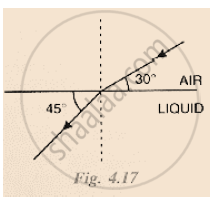
The diagram alongside shows the refraction of a ray of light from sir to a liquid.
(a) write the values of (i) angle of incidence, (ii) angle of refraction.
(b) use snell’s law to find the refractive index of liquid with respect to air.
Analyse the following observation table showing variation of image-distance (v) with object-distance (u) in case of a convex lens and answer the questions that follow without doing any calculations:
| S. No. | Object-Distance u (cm) |
Image-Distance v (cm) |
| 1 | –60 | +12 |
| 2 | –30 | +15 |
| 3 | –20 | +20 |
| 4 | –15 | +30 |
| 5 | –12 | +60 |
| 6 | –9 | +90 |
(a) What is the focal length of the convex lens? State reason for your answer.
(b) For what object-distance (u) is the corresponding image-distance (v) not correct? How did you arrive at this conclusion?
(c) Choose an appropriate scale to draw a ray diagram for the observation at S. No. 4 and find the approximate value of magnification.
A teacher sets up the stand carrying a convex lens of focal length 15 cm at 42.7 cm mark on the optical bench. He asks four students A, B, C and D to suggest the position of screen on the optical bench so that a distinct image of a distant tree is obtained almost immediately on it. The positions suggested by the students were as
A. 12.7 cm
B. 29.7 cm
C. 57.7 cm
D. 72.7 cm
The correct position of the screen was suggested by
(a) A
(b) B
(c) C
(d) D
The focal length of a lens is positive. In this case, state the kind of lens.
State the position of object, position of image, nature of image when: Convex lens is used in observing biological specimens.
State the nature and position of the object on the principal axis to obtain a virtual and magnified image.
Draw a diagram to show the convergent action of a convex lens by treating it as a combination of glass block and two triangular glass prisms, with the aid of two parallel incident rays.
Diagram shows an object AB placed on the principal axis B of a convex lens placed in air. F1 and F2 are the two foci of the lens.
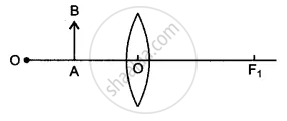
(i) Copy the diagram:
Draw a ray of light starting from B and passing through O. Show the same ray after refraction by the lens. Draw another ray from B which passes through F2 after refraction by the lens. Locate the final image
(ii) Is the image real or virtual?
Observe the given figure and answer the following questions.
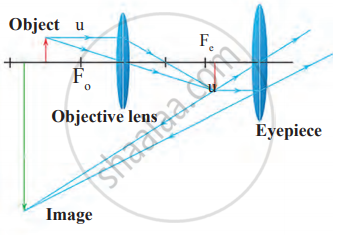
- Where is the above type of lens construction used?
- What type of image is formed by an objective lens?
- What happens instead of placing at Fo if the object is placed in between O and Fo?
Which of the following statements is true?
Convex lens is also known as ______.
