Advertisements
Advertisements
प्रश्न
Write scientific reason.
Adults need bifocal lens spectacle.
Advertisements
उत्तर
- The ability of the ciliary muscles near the eye lens to change the focal length of the lens decreases with age.
- As a result, sometimes adults suffer from both nearsightedness and farsightedness.
Therefore, adults need bifocal lens spectacle.
APPEARS IN
संबंधित प्रश्न
A beam of light travelling in air is incident of water. Draw a ray-diagram indicating the change in its path in water.
What type of lens would you use as a magnifying glass? How close must the object be to the lens?
Describe with the help of a ray-diagram, the formation of image of a finite object placed in front of convex lens between f and 2f. Give two characteristics of the image so formed.
Describe with the help of a ray diagram the nature, size and position of the image formed when an object is placed in front of a convex lens between focus and optical centre. State three characteristics of the image formed.
Find the nature, position and magnification of the images formed by a convex lens of focal length 0.20 m if the object is placed at a distance of:
0.15 m
Which type of lenses are:
thicker in the middle than at the edges?
What would be the diameter of the image of the flower on the film?
Complete the following sentence.
A long-sighted person cannot see ........... objects clearly. Long-sightedness can be corrected by using .............. lenses.
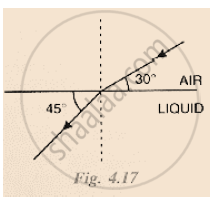
The diagram alongside shows the refraction of a ray of light from sir to a liquid.
(a) write the values of (i) angle of incidence, (ii) angle of refraction.
(b) use snell’s law to find the refractive index of liquid with respect to air.
The focal length of a thin convex lens is ______ than that of a thick convex lens.
A lens forms an inverted image of an object. Name the kind of lens.
In the following cases, where must an object be placed in front of a convex lens so that the image formed is of the same size as the object?
An object is placed perpendicular to the principal axis of a convex lens of focal length 20 cm. The distance of the object from the lens is 30 cm. Find (i) the position (ii) the magnification and (iii) the nature of the image formed.
Draw a diagram to show the convergent action of a convex lens by treating it as a combination of glass block and two triangular glass prisms, with the aid of two parallel incident rays.
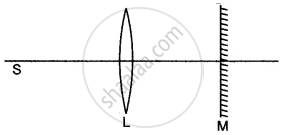
In the figure given below L is a convex lens, M is a plane mirror and S is a point source of light. Rays of light from the source S return to their point of origin. Complete the ray diagram to show this. What is the point S called?
Write the name.
The lens used in simple microscope.
Distinguish between Concave lens and Convex Lens.
Distinguish between:
Concave lens and Convex Lens
Distinguish between:
Concave lens and Convex lens
