Advertisements
Advertisements
प्रश्न
Write the name.
The lens used in simple microscope.
Advertisements
उत्तर
The lens used in simple microscope- Convex
APPEARS IN
संबंधित प्रश्न
Draw a ray diagram to show the formation of image in the above situation
(a) Draw a ray diagram to show the formation of an image by a convex lens when an object is placed in front of the lens between its optical centre and principal focus.
(b) In the above ray diagram, mark the object distance (u) and the image distance (v) with their proper signs (+ve or –ve as per the new Cartesian sign convention) and state how these distances are related to the focal length (f) of the convex lens in this case.
(c) Find the power of a convex lens which forms a real and inverted image of magnification –1 of an object placed at a distance of 20 cm from its optical centre.
An object 5 cm is placed at a distance of 20 cm in front of a convex mirror of radius of curvature 30 cm. Find the position, nature and size of the image.
Analyse the following observation table showing variation of image-distance (v) with object-distance (u) in case of a convex lens and answer the questions that follow without doing any calculations :
| S. No. | Object-Distance u (cm) |
Image-Distance v (cm) |
| 1 | –100 | +25 |
| 2 | –60 | +30 |
| 3 | –40 | +40 |
| 4 | –30 | +60 |
| 5 | –25 | +100 |
| 6 | –15 | +120 |
(a) What is the focal length of the convex lens? Give reason to justify your answer.
(b) Write the serial number of the observation which is not correct. On what basis have you arrived at this conclusion?
(c) Select an appropriate scale and draw a ray diagram for the observation at S.No. 2. Also find the approximate value of magnification.
Study the given ray diagrams and select the correct statement from the following:
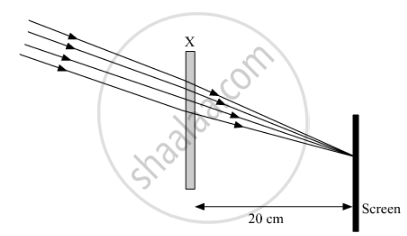
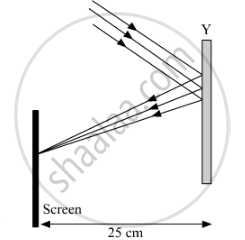
(A) Device X is a concave mirror and device Y is a convex lens, whose focal lengths are 20 cm and 25 cm respectively.
(B) Device X is a convex lens and device Y is a concave mirror, whose focal lengths are 10 cm and 25 cm respectively.
(C) Device X is a concave lens and device Y is a convex mirror, whose focal lengths are 20 cm and 25 cm respectively.
(D) Device X is a convex lens and device Y is a concave mirror, whose focal lengths are 20 cm and 25 cm respectively.
"A lens can form a magnified erect image as well as magnified inverted image of an object placed in front of it." State the nature of this lens and draw ray diagrams to justify the above statement. Mark the positions of O, F and 2F in the diagram.
An object AB is placed between O and F1 on the principal axis of a converging lens as shown in the diagram.
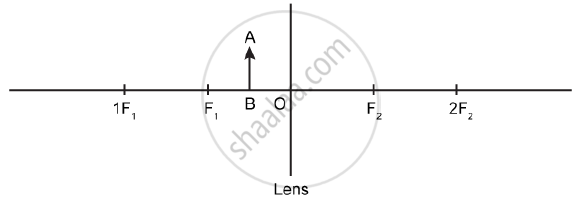
Copy the diagram and by using three standard rays starting from point A, obtain an image of the object AB.
Distinguish between a convex lens and concave lens. Which of the two is a converging lens : convex lens of concave lens?
Define the principal axis of a convex lens.
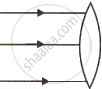
What type of lens is shown in the diagram on the right? What will happen to the parallel rays of light? Show by completing the ray diagram.
State whether the convex lens has a real focus or a virtual focus.
A burning candle whose flame is 1.5 cm tall is placed at a certain distance in front of a convex lens. An image of candle flame is received on a white screen kept behind the lens. The image of flame also measures 1.5 cm. If f is the focal length of convex lens, the candle is placed:
(a) at f
(b) between f and 2f
(c) at 2f
(d) beyond 2f
What kind of lens can form:
an erect magnified image?
An object is placed 20 cm from (a) a converging lens, and (b) a diverging lens, of focal length 15 cm. Calculate the image position and magnification in each case.
A lens forms an upright and magnified image of an object. Name the lens.
When you focus the image of a distant flag, whose shape is given below, on a screen using a convex lens, the shape of the image as it appears on the screen is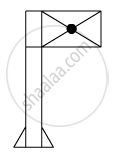
(A)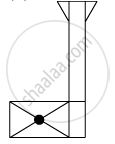
(B)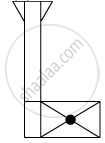
(C)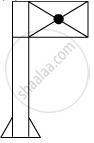
(D)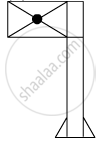
State the position of object, position of image, nature of image when: Convex lens is used as an erecting lens in terrestrial telescope.
Diagram shows an object AB placed on the principal axis B of a convex lens placed in air. F1 and F2 are the two foci of the lens.
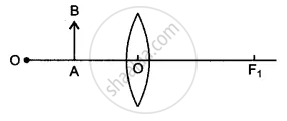
(i) Copy the diagram:
Draw a ray of light starting from B and passing through O. Show the same ray after refraction by the lens. Draw another ray from B which passes through F2 after refraction by the lens. Locate the final image
(ii) Is the image real or virtual?
Differentiate convex lens and concave lens.
A convex lens of focal length 20 cm can produce a magnified virtual as well as real image. Is this a correct statement? If yes, where shall the object be placed in each case for obtaining these images?
