Advertisements
Advertisements
Question
Write the name.
The lens used in simple microscope.
Advertisements
Solution
The lens used in simple microscope- Convex
APPEARS IN
RELATED QUESTIONS
Write one condition where it does not bend when entering a medium of different optical density.
If the image formed by a convex lens is of the same size as that of the object, what is the position of the image with respect to the lens?
Where should an object be placed in front of a convex lens so as to obtain its real, inverted and magnified image?
Describe with the help of a ray-diagram, the formation of image of a finite object placed in front of convex lens between f and 2f. Give two characteristics of the image so formed.
Describe with the help of a ray-diagram, the size, nature and position of the image formed by a convex lens when an object is placed beyond 2f in front of the lens.
With the help of a labelled diagram explain how a convex lens converges a beam of parallel light rays. Mark the principal axis, optical centre, principal focus and focal length of the convex lens on the diagram.
A convex lens of focal length 8 cm forms a real image of the same size as the object. The distance between object and its image will be:
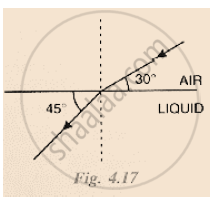
The diagram alongside shows the refraction of a ray of light from sir to a liquid.
(a) write the values of (i) angle of incidence, (ii) angle of refraction.
(b) use snell’s law to find the refractive index of liquid with respect to air.
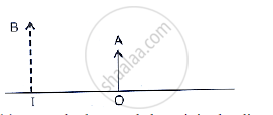
The given below figure shows an object OA and its image IB formed by a lens.
A lens forms an inverted image of an object. Name the kind of lens.
In the following cases, where must an object be placed in front of a convex lens so that the image formed is of the same size as the object?
Out of the five incident rays shown in the figure find the three rays that are obeying the laws of refraction and may be used for locating the position of image formed by a convex lens:
(A) 1, 2 and 3
(B) 2, 3 and 4
(C) 3, 4 and 5
(D) 1, 2 and 4
Distinguish between:
Concave lens and Convex lens
How will you decide whether a given piece of glass is a concave lens, convex lens, or a plane glass plate?
A concave mirror and convex lens are held in water. What changes, if any, do you expect in their focal length?
Why do we say that the ‘2F’ and ‘F’ points of a convex lens can be regarded as a sort of ‘turning points’ as far as the nature of the image formed by it is concerned?
We can burn a piece of paper by focussing the sun rays by using a particular type of lens. Name the type of lens used for the above purpose. Draw a ray diagram to support your answer.
Write scientific reason.
Adults need bifocal lens spectacle.
Differentiate convex lens and concave lens.
