Advertisements
Advertisements
प्रश्न
Write the name.
The lens used in simple microscope.
Advertisements
उत्तर
The lens used in simple microscope- Convex
APPEARS IN
संबंधित प्रश्न
(a) Draw a ray diagram to show the formation of image by a concave lens when an object is placed in front of it.
(b) In the above diagram mark the object distance (u) and the image distance (v) with their proper signs (+ve or –ve as per the new Cartesian sign convention) and state how these distances are related to the focal length (f) of the concave lens in the case.
(c) Find the nature and power of a lens which forms a real and inverted image of magnification –1 at a distance of 40 cm from the optical centre.
A student has obtained a magnified image of a flame on a screen using a convex lens. To draw the corresponding ray diagram to show the image formation, which of the following two rays whose paths after refraction are shown, should he select ?
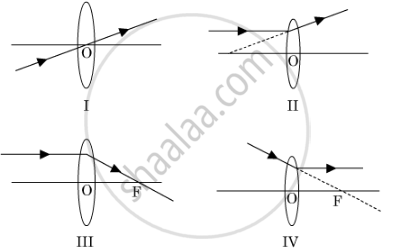
(A) I and II
(B) II and III
(C) III and IV
(D) I and III
An object of height 4.0 cm is placed at a distance of 30 cm from the optical centre 'O' of a convex lens of focal length 20 cm. Draw a ray diagram to find the position and size of the image formed. Mark optical centre 'O' and principal focus 'F' on the diagram. Also find the approximate ratio of size of the image to the size of the object.
What is a lens?
Define the principal axis of a convex lens.
A student did an experiment with a convex lens. He put an object at different distances 25 cm, 30 cm, 40 cm, 60 cm and 120 cm from the lens. In each case he measured the distance of the image from the lens. His results were 100 cm, 24 cm, 60 cm, 30 cm and 40 cm, respectively. Unfortunately his results are written in wrong order.
- Rewrite the image distances in the correct order.
- What would be the image distance if the object distance was 90 cm?
- Which of the object distances gives the biggest image?
- What is the focal length of this lens?
What kind of lens can form:
an inverted magnified image?
Study the diagram below.
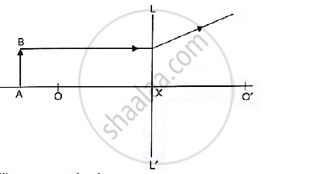
what are the points O, O’ called?
A lens forms an upright and magnified image of an object. Name the lens.
A convex lens has a divergent action and a concave lens has a convergent action.
To find the image distance for varying object distances in case of a convex lens of focal length 15 cm, a student obtains on a screen a sharp image of a bright object by placing it at 20 cm distance from the lens. After that he gradually moves the object away from the lens and each time focuses the image on the screen.
(a) In which direction-towards or away from the lens does he move the screen to focus the object?
(b) How does the size of image change?
(c) Approximately at what distance does he obtain the image of magnification –1?
(d) How does the intensity of image change as the object moves farther and farther away from the lens?
If you are to determine to focal length of a convex lens, you should have
(A) a convex lens and a screen
(B) a convex lens and a lens holder
(C) a lens holder, a screen holder and a scale
(D) a convex lens, a screen, holder for them and a scale
For which position of the object does a convex lens form a virtual and erect image? Explain with the help of a ray diagram.
State the position of object, position of image, nature of image when: Convex lens is used as objective lens of photographic camera.
State the nature and position of the object on the principal axis to obtain a virtual and magnified image.
How will you determine the focal length of a convex lens by the plane mirror method?
Define the terms principal foci and focal lengths as applied to a convex lens, and show them with the help of proper diagrams.
