Advertisements
Advertisements
प्रश्न
पर्याय
40 cm
25 cm
`1/40` cm.
`1/25` cm
Advertisements
उत्तर
The power of a convex lens is 2.5 dioptres. Its focal length is 40 cm.
APPEARS IN
संबंधित प्रश्न
A student is using a convex lens of focal length 18 cm to study the image formation by it for the various positions of the object. He observes that when he places the object at 27 cm, the location of the image is at 54 cm on the other side of the lens. Identify from the following diagram the three rays that are obeying the laws of refraction and may be used to draw the corresponding ray diagram.

(A) 1, 2 and 4
(B) 1, 3 and 5
(C) 2, 4 and 5
(D) 2, 3 and 4
When a ray of light enters from one medium to another having different optical densities it bends. Why does this phenomenon occur?
Write one condition where it does not bend when entering a medium of different optical density.
An object of height 4.0 cm is placed at a distance of 30 cm from the optical centre 'O' of a convex lens of focal length 20 cm. Draw a ray diagram to find the position and size of the image formed. Mark optical centre 'O' and principal focus 'F' on the diagram. Also find the approximate ratio of size of the image to the size of the object.
An object AB is placed between O and F1 on the principal axis of a converging lens as shown in the diagram.
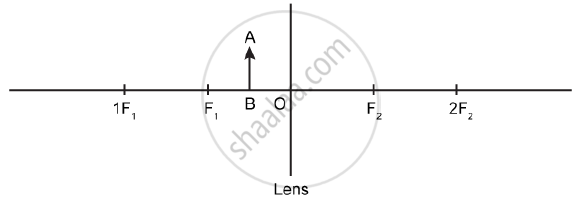
Copy the diagram and by using three standard rays starting from point A, obtain an image of the object AB.
A beam of light travelling in a rectangular glass slab emerges into air. Draw a ray-diagram indicating the change in its path.
If an object is at a considerable distance (or infinity) in front of a convex lens, where is the image formed?
What type of lens would you use as a magnifying glass? How close must the object be to the lens?
State any two uses of convex lenses.
Define the principal axis of a convex lens.
Name one simple optical instrument in which the above arrangement of convex lens is used.
The focal length of a thin convex lens is ______ than that of a thick convex lens.
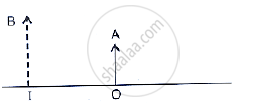
The given below figure shows an object OA and its image IB formed by a lens. State three characteristics of the image.
In the following cases, where must an object be placed in front of a convex lens so that the image formed is of the same size as the object?
Observe the following figure and complete the table:

| Points | Answer |
| (i) Position of the object | |
| (ii) Position of the image | |
| (iii) Size of the image | |
| (iv) Nature of the image |
(a) What type of a lens can be used as a magnifying glass?
(b) Show by a ray diagram the formation of a real image by simple magnifying lens.
Write the three characteristics of the image formed by a convex lens of focal length 20 cm for the object at distance (i) 10 cm, (ii) 30 cm, (iii) 40 cm, (iv) 60 cm from the lens.
For a specific glass lens f = 0.5 m. This is the only information given to the student. Which type of lens is given to him and what is its power?
- In which type of microscope do you find the lens arrangement as shown in the following diagram?

- Write about the working and the use of this microscope.
Distinguish between:
Concave lens and Convex lens
