Advertisements
Advertisements
प्रश्न
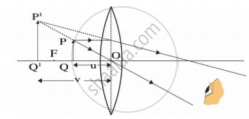 : Object near the lens : : ______ :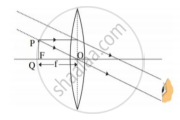
Advertisements
उत्तर
: Object near the lens : : Object at focus :
APPEARS IN
संबंधित प्रश्न
"A convex lens can form a magnified erect as well as magnified inverted image of an object placed in front of it." Draw ray diagram to justify this statement stating the position of the object with respect to the lens in each case.
An object is placed at a distance of 15 cm from a concave lens of focal length 30 cm. List four characteristics (nature, position, etc.) of the image formed by the lens.
Draw a labelled ray diagram to show how a ray of light passes through a parallel-sided glass block if it hits the glass block at 90° (that is, perpendicular to the glass block).
For what position of an object a real, diminished image is formed by a convex lens?
Three convex lenses are available having focal lengths of 4 cm, 40 cm and 4 m respectively. Which one would you choose as a magnifying glass and why?
Which of the above two cases illustrates the working of a magnifying glass?
Find the nature, position and magnification of the images formed by a convex lens of focal length 0.20 m if the object is placed at a distance of:
0.15 m
How would a pencil look like if you saw it through a convex lens? (Assume the pencil is close to the lens). Is the image real or virtual?
A lens forms an upright and magnified image of an object. Name the lens.
When you focus the image of a distant flag, whose shape is given below, on a screen using a convex lens, the shape of the image as it appears on the screen is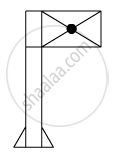
(A)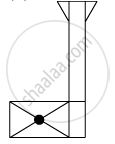
(B)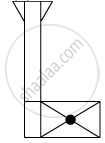
(C)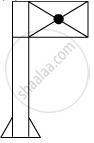
(D)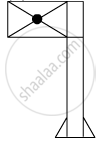
The image obtained while finding the focal length of convex lens is ....................
Yesh find out F1 and F2 of symmetric convex lens experimentally then which conclusion is true.
Where should an object be placed in front of a convex lens to get a real image of the size of the object?
The focal length of a lens is positive. In this case, state the kind of lens.
A candle is placed between f and 2f a convex lens. Draw a ray diagram showing the position of the image.
We can burn a piece of paper by focussing the sun rays by using a particular type of lens. Name the type of lens used for the above purpose. Draw a ray diagram to support your answer.
Diagram shows an object AB placed on the principal axis B of a convex lens placed in air. F1 and F2 are the two foci of the lens.
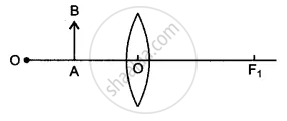
(i) Copy the diagram:
Draw a ray of light starting from B and passing through O. Show the same ray after refraction by the lens. Draw another ray from B which passes through F2 after refraction by the lens. Locate the final image
(ii) Is the image real or virtual?
Which of the following statements is true?
