Advertisements
Advertisements
Question
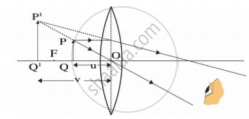 : Object near the lens : : ______ :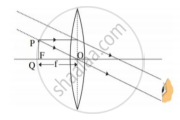
Advertisements
Solution
: Object near the lens : : Object at focus :
APPEARS IN
RELATED QUESTIONS
Analyse the following observation table showing variation of image-distance (v) with object-distance (u) in case of a convex lens and answer the questions that follow without doing any calculations :
| S. No. | Object-Distance u (cm) |
Image-Distance v (cm) |
| 1 | –100 | +25 |
| 2 | –60 | +30 |
| 3 | –40 | +40 |
| 4 | –30 | +60 |
| 5 | –25 | +100 |
| 6 | –15 | +120 |
(a) What is the focal length of the convex lens? Give reason to justify your answer.
(b) Write the serial number of the observation which is not correct. On what basis have you arrived at this conclusion?
(c) Select an appropriate scale and draw a ray diagram for the observation at S.No. 2. Also find the approximate value of magnification.
An object is placed at a distance of 15 cm from a convex lens of focal length 20 cm. List four characteristics (nature, position, etc.) of the image formed by the lens.
Draw a ray diagram to show the formation of the image of an object be placed so that a real and inverted image of the same size as the object is obtained using a convex lens
Draw a labelled ray diagram to show how a ray of light passes through a parallel-sided glass block if it hits the glass block at an angle other than 90° (that is, obliquely to the glass block).
For what position of an object a real, diminished image is formed by a convex lens?
Describe with the help of a ray diagram the nature, size and position of the image formed when an object is placed in front of a convex lens between focus and optical centre. State three characteristics of the image formed.
A burning candle whose flame is 1.5 cm tall is placed at a certain distance in front of a convex lens. An image of candle flame is received on a white screen kept behind the lens. The image of flame also measures 1.5 cm. If f is the focal length of convex lens, the candle is placed:
(a) at f
(b) between f and 2f
(c) at 2f
(d) beyond 2f
- An object 3 cm high is placed 24 cm away from a convex lens of focal length 8 cm. Find by calculations, the position, height and nature of the image.
- If the object is moved to a point only 3 cm away from the lens, what is the new position, height and nature of the image?
- Which of the above two cases illustrates the working of a magnifying glass?
Find the nature, position and magnification of the images formed by a convex lens of focal length 0.20 m if the object is placed at a distance of:
0.15 m
What kind of lens can form:
an inverted magnified image?
What would be the diameter of the image of the flower on the film?
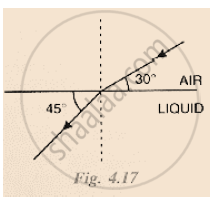
The diagram alongside shows the refraction of a ray of light from sir to a liquid.
(a) write the values of (i) angle of incidence, (ii) angle of refraction.
(b) use snell’s law to find the refractive index of liquid with respect to air.
A convex lens has a divergent action and a concave lens has a convergent action.
List four properties of the image formed by a convex mirror.
The image obtained while finding the focal length of convex lens is ....................
The focal length of a lens is positive. In this case, state the kind of lens.
Out of the two lenses one concave and the other convex state which is a convergent or a divergent type of a lens. Give a reason for your answer.
 |
 |
The above images are that of a specialized slide projector. Slides are small transparencies mounted in sturdy frames ideally suited to magnification and projection since they have a very high resolution and a high image quality. There is a tray where the slides are to be put into a particular orientation so that the viewers can see the enlarged erect images of the transparent slides. This means that the slides will have to be inserted upside down in the projector tray.
To show her students the images of insects that she investigated in the lab, Mrs. Iyer brought a slide projector. Her slide projector produced 500 times enlarged and inverted image of a slide on a screen 10 m away.
a. Based on the text and data given in the above paragraph, what kind of lens must the slide projector have?
b. If v is the symbol used for image distance and u for object distance then with one reason state what will be the sign for `"𝑣"/"𝑢"` in the given case?
c. A slide projector has a convex lens with a focal length of 20 cm. The slide is placed upside down 21 cm from the lens. How far away should the screen be placed from the slide projector’s lens so that the slide is in focus?
OR
c. When a slide is placed 15 cm behind the lens in the projector, an image is formed 3 m in front of the lens. If the focal length of the lens is 14 cm, draw a ray diagram to show image formation. (not to scale)
Distinguish between:
Concave lens and Convex Lens
Distinguish between:
Concave lens and Convex lens
